
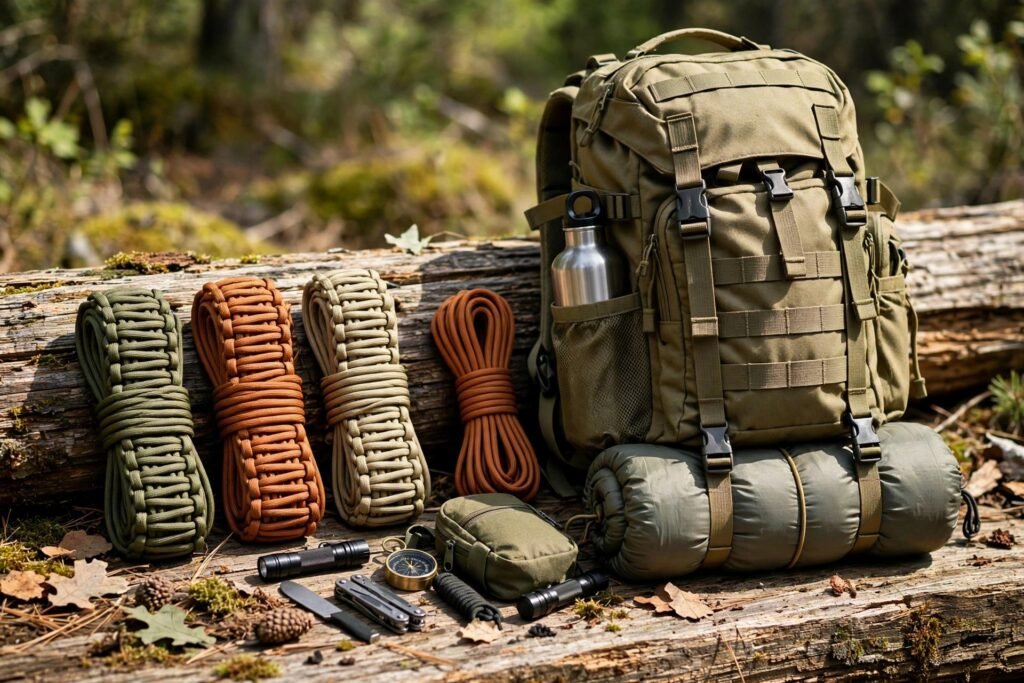
A bug out bag fails in boring ways. A strap snaps. A tent fly will not stay tight in wind. A zipper pull breaks at the worst moment. That is exactly where paracord earns its weight — not as a miracle rope, but as light, compact cordage you can cut, tie, and re-use for dozens of small jobs that keep the rest of your kit working.
This guide covers how much paracord to pack for a 72-hour bug out bag, how to carry it so it does not tangle, and nine uses that actually matter in the field. No fantasy scenarios, no fake mil-spec claims. Just honest numbers and practical knots.
How Much Paracord for a Bug Out Bag?
Pack 50 feet of genuine 550 paracord as your baseline. Add a second 25-foot hank of 275 or 550 cord if your bag has room. That total — 50 to 75 feet — covers shelter, repairs, and lashing without adding serious weight.
Here is the math. Fifty feet of 550 cord weighs roughly 3.5 to 4 ounces and coils to about the size of a fist. It breaks down like this in real use:
| Job | Typical Cord Needed |
|---|---|
| Ridgeline for a tarp shelter | 25–30 ft (one continuous length) |
| Four tarp guy lines | 4 × 4–6 ft = 16–24 ft |
| Boot lace replacement (one boot) | 45–54 inches |
| Pack repair / lashing gear | 3–10 ft per job |
| Clothesline | 10–15 ft |
That is why one 50-foot hank disappears fast if you cut it carelessly. The smarter split most people use is: keep 30 feet uncut for a ridgeline or clothesline, and pre-cut the other 20 feet into two 10-foot working lengths for guy lines and repairs. If you carry 75 feet, keep 50 feet whole and 25 feet as working lengths.
Not sure how lengths translate for bracelets, belts, or other gear you might unravel in an emergency? Run your numbers through our Paracord Length Calculator before you pack, and check the full paracord length chart for project-by-project amounts.
550, 275, or Both?
For a bug out bag, 550 is the default for a reason. Genuine 550 cord has a minimum break strength of 550 pounds, a diameter of about 4mm, and 7 inner strands (in mil-spec construction) that you can pull out for finer jobs like sewing repairs or fishing line in a true emergency. See our full breakdown of 550 paracord specs for diameter, strand count, and stretch.
275 cord (about 2.5mm, 275-pound break strength) is lighter and packs smaller. It will not replace 550 for shelter ridgelines under load, but it is excellent for guy lines, zipper pulls, and lanyards. Many bags carry mostly 550 with a short hank of 275 as the everyday tying cord, so the heavy cord stays in reserve.
Whatever you pack, buy real nylon cord from a reputable maker and test a sample at home. If the sheath feels papery, the core is lumpy, or the cord flattens when you pinch it, do not trust it in a bag. Our guide to best paracord explains what to look for, and how much paracord do I need covers amounts for other kits.
How to Carry Paracord Without the Tangle
Loose cord in the bottom of a pack becomes a knot you will be picking apart in the dark. Three carry methods work:
1. The Figure-Eight Hank
Wrap cord in a figure-eight between thumb and elbow or around a notched card, then wrap the tail around the middle 6–8 times and tuck it. It feeds out without twisting and re-wraps in under a minute.
2. The Bracelet or Belt Reserve
A woven bracelet holds 8–12 feet, a belt can hold 80 feet or more, but unraveling takes time and you lose the item. Treat wearable cord as a backup, not your main supply. Our bug out bag checklist puts wearable cord in that backup role for the same reason.
3. The Donut (Paracord Grenade Alternative)
Coil cord into a tight donut by wrapping around three fingers, feeding each new wrap through the center. It is compact, tangle-free, and fits a side pocket.
Store cord dry, out of constant sun, and check it once or twice a year. Nylon weakens with long UV exposure and abrasion. If a section is frayed or stiff, cut it out and keep the good lengths.
9 Bug Out Bag Uses That Actually Matter
1. Tarp Shelter Ridgeline and Guy Lines
This is use number one. Run your uncut 30-foot length between two trees about head height, tie it taut with a trucker’s hitch for mechanical advantage, drape the tarp over it, and stake the corners with 4–6 foot guy lines. That setup handles rain well.
2. Tent and Gear Repairs
Broken guy line, torn loop, snapped zipper pull — cord fixes all three in minutes. A 6-inch loop makes a zipper pull, a short length replaces a guy line, and inner strands can stitch a torn strap well enough to get home.
3. Lashing and Pack Repairs
When a shoulder strap or hip belt starts to tear, lash it tight with several wraps and a square knot rather than trusting one stitch. Cord also lashes extra gear — a wet jacket, a water container — to the outside of a full pack.
4. Clothesline
Wet socks and base layers will not dry inside a bag. A 10–15 foot line between trees, with small loops tied every foot or so, dries clothing overnight and keeps morale and feet in much better shape on day two.
5. Boot and Shoe Laces
Cut 45–54 inches, melt the ends so they feed through eyelets, and lace as normal. 550 cord is slightly thick for small dress eyelets but works in most boots and trail shoes. Melt ends outdoors or with ventilation — nylon fumes are not something to breathe in a tent.
6. First-Aid Support — With Honest Limits
Cord can tie a splint (padded sticks lashed above and below an injury) and can secure a sling. It is not a tourniquet substitute and should never be tied directly tight around a limb to stop bleeding — use a proper tourniquet from your first-aid kit for that, and get training. Paracord supports first aid; it does not replace it. See best cordage for survival kits for how cord fits alongside real medical gear.
7. Hauling and Lowering
Haul a pack up a steep bank, lower gear down a drop, or drag firewood without tearing your hands. Tie with a bowline or figure-eight loop, keep loads modest, and never use paracord for climbing or rappelling — 550-pound break strength is a static minimum, not a climbing rating, and a fall multiplies force far beyond it.
8. Food Hanging and Camp Security
In bear country or where raccoons raid camps, hang food from a branch 10+ feet up using a long length over the limb. Cord also makes simple perimeter lines with cans or bells around a camp — low-tech, but it wakes you up.
9. Inner Strands for Fine Jobs
Pull out the inner strands for sewing repairs, dental floss in a pinch (plain, unwaxed core only, and only if nothing else exists), fishing line for improvised fishing, or snare wire support — check local laws, as snares are restricted in many places. This strand trick is why genuine multi-strand cord beats cheap single-core copies. More everyday ideas are in our full list of paracord uses.
What Paracord Cannot Do
Honest limits matter more than hype. Paracord cannot safely hold a falling person. It cannot replace a rated tourniquet, a climbing rope, or a tow strap for a vehicle. It stretches under load (nylon elongation is roughly 15–30% depending on construction), so it is a poor choice where zero stretch matters. And old, sun-rotted, or abraded cord loses strength you cannot see — retire suspect cord to non-critical jobs.
Knowing those limits is what makes the nine uses above trustworthy. Cord that is right for shelter and repairs does not need to pretend to be rescue gear.
A Simple Packing Plan
- Main hank: 50 ft of 550 cord — 30 ft kept whole, 20 ft as two 10-ft working lengths
- Optional extra: 25 ft of 275 or 550 for guy lines and small jobs
- Wearable backup: bracelet (8–12 ft) — backup only
- Tools with it: small lighter for melting cut ends, 2–3 feet of tape wrapped on an old card for quick fixes
- Check: inspect and re-coil every 6 months; replace frayed sections
Weigh the full cord kit. For most people it lands at 4–6 ounces — one of the best weight-to-usefulness ratios in the entire bag. Use the Paracord Length Calculator if you are adding cord projects like a belt or leash to your kit and want exact amounts before you buy.
FAQ
How much paracord should be in a 72-hour bug out bag?
50 feet of 550 paracord is a solid baseline for one person for 72 hours. It covers a tarp ridgeline, guy lines, and repairs. If you have room, add 25 feet more as working lengths. Groups or larger shelters need proportionally more.
Is 550 paracord strong enough for shelter?
Yes, for tarp ridgelines and guy lines. Genuine 550 cord has a 550-pound minimum break strength, far above tarp loads in wind when tied correctly. It is not rated for climbing or holding a person’s fall — never use it for those jobs.
Should I pre-cut my paracord or keep it in one length?
Keep most of it long. A 30-foot uncut length gives you a ridgeline or clothesline you cannot make from short pieces. Pre-cut only a smaller portion (about 20 feet) into 10-foot working lengths for repairs and guy lines.
How long does paracord last in a bug out bag?
Stored dry and out of sunlight inside a bag, nylon paracord lasts for years. Inspect it every 6 months for fraying, stiffness, or mildew. UV and abrasion are the main enemies — cord left in constant sun or dragged over sharp rock should be retired sooner.