
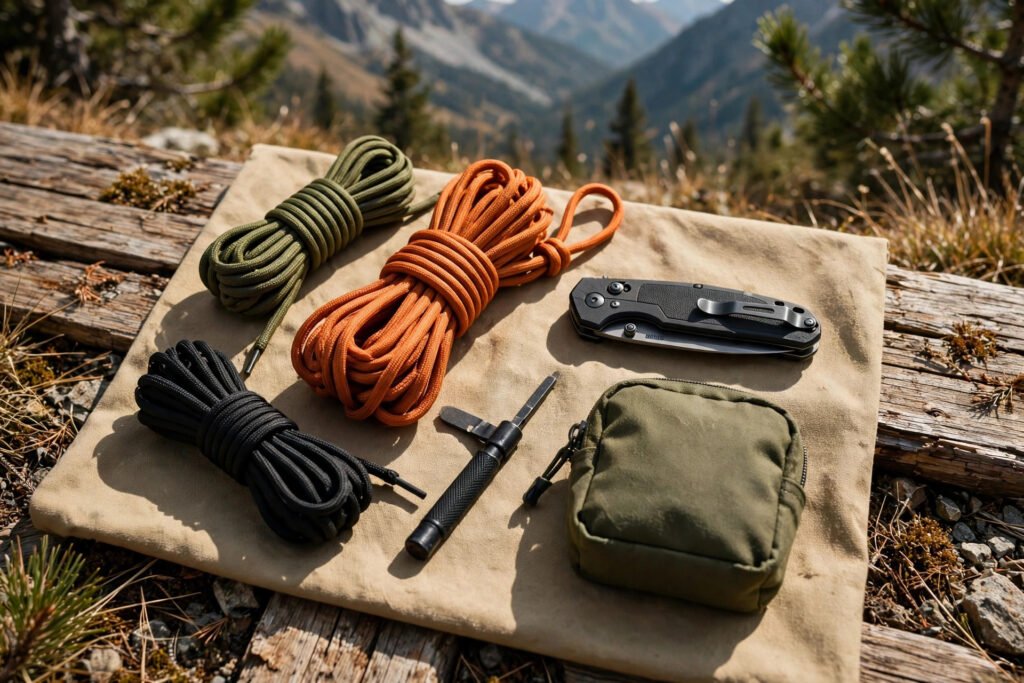
Most survival kits carry exactly one kind of cordage, chosen by habit: a hank of 550 paracord. It is a good habit — paracord is the most versatile cordage in this comparison — but it is not the whole answer. Cordage is weight, and every job in a kit has a cord that does it better, lighter, or cheaper. The kits that earn their keep carry a deliberate mix.
This guide compares the four cordages worth considering — 550 paracord, tarred bank line (#36), micro cord, and Kevlar thread line — on the things that matter in the field: strength, pack weight, knot behavior, and what each is actually best at. It pairs with our bug-out bag checklist, which shows where each cordage sits in a complete kit.
550 paracord: the generalist
Type III paracord — 550 lb minimum break strength, seven inner strands, about 4 mm diameter — is the benchmark. Its party trick is the construction: gut it and the seven twisted inner strands become sewing thread, fishing line, and snare material, so one hank is really two cordages. (If the type system is new to you, paracord types explained covers it in full.)
Strengths: highest versatility, strong for lashing and shelter work, easy to untie and reuse, strands multiply its uses. Weaknesses: bulkiest and heaviest per foot here; knots are large; overkill for trotlines and netting, where you want hundreds of feet, not dozens. Weight: a 100 ft hank runs roughly 7–8 oz depending on maker.
Best roles: shelter ridgelines and lashing, gear repair (whole and gutted), the core cordage of any kit.
Tarred bank line #36: the volume player
Bank line is twisted (or braided) nylon twine, tarred for water and abrasion resistance. The #36 size is the survival-kit standard: roughly 320–340 lb break strength — check your maker’s rating, as it varies — at a fraction of paracord’s bulk.
Strengths: enormous length per ounce (a small spool carries 300+ ft), the tar makes it grip knots and resist rot and UV, and it is cheap enough to cut without flinching. Weaknesses: no inner strands to harvest, the tar is messy on hands and gear, thin line cuts into hands under load, and it is miserable to untie once loaded hard. Weight: about 1 lb buys you well over 1,000 ft.
Best roles: trotlines, gill nets, and snares in quantity; shelter stake lines; lashing where the cord stays tied; any job measured in hundreds of feet.
Micro cord: the lightweight
Micro cord is the small end of the paracord family: braided cord around 1.18 mm rated near 90–100 lb (sold as 95 lb), with its slightly bigger sibling 275 cord (Type II class, about 3 mm) for heavier light work. No guttable strands at this size — what you see is the cord.
Strengths: featherweight, ties tiny clean knots, perfect for the hundred small jobs that waste paracord: gear loops, zipper pulls, lanyards, guy-line adjusters, hanging lights. Weaknesses: too light for shelter structure or any load you care about; thin cord is harder to handle with gloves or cold hands. Weight: 125 ft weighs about an ounce — effectively free.
Best roles: everyday-carry cordage, kit finishing touches, tent and tarp adjuster lines, fishing-kit backup line.
Kevlar thread line: the specialist
Kevlar cordage — braided aramid line sold in strengths from about 200 lb up — plays a different sport: extreme strength for its diameter, high heat and cut resistance, and almost no stretch. It saws through wood as an improvised friction tool and survives conditions that melt nylon.
Strengths: heat resistance, abrasion and cut resistance, strength at thread-like diameters. Weaknesses: poor knot behavior — Kevlar slips, weakens sharply at tight bends and knots, and degrades in UV; it is also the most expensive per foot here and unforgiving to handle. Best roles: a short length in a repair or escape-and-evasion niche, fire-adjacent lashing, and as a cutting/friction line — a 10–25 ft piece is plenty for a kit. It is a spice, not a staple.
Side by side
| Cordage | Break strength | Length per weight | Knots | Signature use |
|---|---|---|---|---|
| 550 paracord | 550 lb (min, spec) | ~100 ft / 7–8 oz | Easy, reusable | Shelter, lashing, gutted strands |
| Bank line #36 | ~320–340 lb | 1,000+ ft / ~1 lb | Grips hard, messy | Nets, trotlines, volume lashing |
| Micro cord (95) | ~95 lb | 125 ft / ~1 oz | Tiny, clean | Gear loops, lanyards, adjusters |
| Kevlar line | ~200 lb+ (varies) | Short lengths | Slippery, bend-sensitive | Heat/cut niche work |
The kit mix we recommend
For a standard bug-out or vehicle kit, carry all three main cordages — they complement rather than compete:
- 50–100 ft of 550 paracord — structure and repair. Buy honest construction; our best paracord guide names what to look for.
- One spool of #36 tarred bank line (300+ ft) — everything measured in hundreds of feet.
- 125 ft of micro cord — the small jobs, at an ounce.
- Optional: 10–25 ft of Kevlar line — only if your kit has a repair or heat niche for it.
Total cordage weight lands around a pound and a half, and there is no realistic camp, repair, fishing, or shelter job that mix cannot cover. The full packing context is in the bug-out bag checklist.
Two packing details make the mix work harder. Pre-cut some of it: two 25 ft paracord hanks deploy faster than one 50 ft hank you have to measure in the rain, and a 10 ft length of bank line rides well in a pocket. And daisy-chain or hank your cord properly — cordage that comes out of the bag as a tangled bird’s nest will get left behind next time, which is how kits quietly lose capabilities.
Care, inspection, and replacement
Cordage fails quietly. Nylon loses strength under long UV exposure, abrades where it runs over edges, and hides damage inside the sheath. Once a year, when you refresh the kit, pull every hank out and run it through your hands: feel for flat spots, stiff sections, and frayed sheath, and look for the pale, fuzzy wear that marks serious abrasion. Retire anything questionable to camp-chore duty and replace it in the kit — cord is the cheapest insurance in the bag.
Store cordage dry, out of sunlight, and away from solvents and battery acid, which attack nylon. Bank line’s tar coating shrugs off storage abuse best of the four; Kevlar is the diva, degrading in UV even in storage near a window. Label hanks with type and length on a wrap of tape — in the field, at dusk, “the black cord” is not a specification.
FAQ
If I can only carry one cordage, which one?
550 paracord, 50 ft minimum. Gutting the inner strands gives you light line on demand, which no other single cordage here can imitate.
Is bank line stronger than paracord?
No — #36 bank line breaks around 320–340 lb against paracord’s 550. Bank line wins on length per ounce, not strength. Choose by the job, not the headline number.
Why not just carry more paracord instead of a mix?
Because bulk is the constraint. The same weight that buys 100 ft of paracord buys over 1,000 ft of bank line — and netting, trotlines, and big lashing jobs eat hundreds of feet. A mix covers both worlds.
Does tarred bank line rot or go bad in a kit?
The tar coating resists water, mildew, and UV better than untreated twine, and sealed in a kit it keeps for years. Check it when you refresh the kit annually, like everything else.