
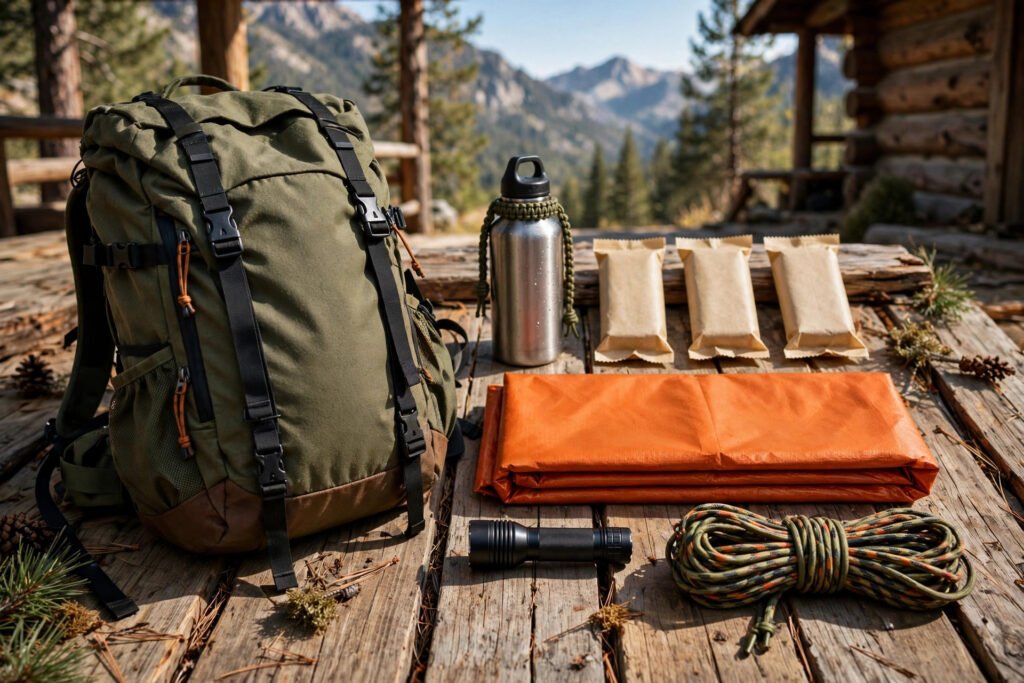
A bug out bag is a 72-hour bridge: enough water, food, shelter, and tools to get you from your front door to somewhere safe, on foot if necessary, for three days. Most published lists fail in one of two directions — they are shopping catalogs with no organizing logic, or fantasy loadouts no one could carry for a mile. This checklist is organized by system, because that is how you should think when packing: for each thing your body needs, there is a primary answer and a backup answer in the bag.
Use it as a checklist, not a purchase order. Tick each system off with gear you already own before buying anything.
The Weight Rule
Keep the total bag weight at or under roughly 20% of your body weight. A 150 lb person should aim for about 30 lb loaded; a 200 lb person, about 40 lb. That is a rule of thumb, not a law — a fit hiker can carry more, a sedentary person or a child far less — but it is the right starting point, because water alone will eat a third of the budget. Weigh the finished bag on a bathroom scale. Almost everyone’s first build is 10 lb too heavy, and the fix is always the same: duplicate tools and “just in case” gear come out; water, insulation, and calories stay.
Water
Water is the heaviest and least negotiable system. Plan on at least 1 liter per person per day as a bare floor — 2 to 3 liters a day is more realistic with walking involved.
- [ ] 2–3 liters of stored water in the bag (rigid bottle plus a collapsible reservoir)
- [ ] Squeeze-style water filter (your primary treatment)
- [ ] Purification tablets (your backup treatment — weighs almost nothing)
- [ ] Metal bottle or cup that can boil water (your third treatment)
- [ ] Electrolyte packets (a few; plain water alone under heavy exertion is not enough)
Three ways to treat water is not paranoia; filters clog, get lost, and freeze. Redundancy here is cheap and light.
Food
Target roughly 2,000 calories per day for three days — about 6,000 calories in the bag — in food that needs no cooking. Eating less for three days is survivable; eating nothing while walking all day is a fast route to bad decisions.
- [ ] 6,000 calories of no-cook food: bars, nut butter, trail mix, dried fruit, jerky, hard candy
- [ ] A few comfort items (coffee packets, tea, hot sauce) — morale is a real factor on day two
- [ ] Spoon/utensil
- [ ] A day’s worth of the same food rotated through your normal pantry, so nothing expires in the bag
Skip freeze-dried meals that require boiling water as your only plan: they spend your fuel and water budgets to save a few ounces.
Shelter and Sleep
Your shelter system has one job: keep you dry and keep your body heat in. Size it to your actual climate’s worst 72 hours, not to the brochure photo.
- [ ] Tarp (a 10×10 ft tarp pitches a dozen ways) or a lightweight bivvy
- [ ] Sleeping bag or quilt rated to your local low temperatures, in a waterproof stuff sack
- [ ] Sleeping pad — insulation from the ground matters more than cushioning
- [ ] Emergency space blanket (backup and signaling)
- [ ] 50–100 ft of paracord for ridgelines and pitch points (see the tools section below)
Fire
Three independent ways to make fire, plus tinder that lights when everything is wet.
- [ ] Disposable lighter (two, in different pockets of the bag)
- [ ] Ferro rod and striker
- [ ] Waterproof matches in a sealed case
- [ ] Prepared tinder: cotton balls with petroleum jelly, or commercial fire tabs, in a waterproof bag
First Aid and Health
This is a personal kit, not an ambulance. Cover bleeding, blisters, and your own medical reality first.
- [ ] Tourniquet and pressure bandage
- [ ] Gauze, adhesive bandages, medical tape
- [ ] Blister care (moleskin or hydrocolloid plasters) — blisters end more walks than anything else
- [ ] Tweezers, safety pins, antiseptic wipes
- [ ] Pain relievers, antihistamines, any personal medication — a 7-day supply, not 3, because pharmacies may be part of the disruption
- [ ] Prescription glasses backup, if you wear them
- [ ] Hand sanitizer, soap, sunscreen, insect repellent
Tools and Repair
- [ ] Fixed-blade knife or a sturdy folding knife
- [ ] Multitool
- [ ] 50–100 ft of 550 paracord — ridgelines, lashings, gear repair, bootlaces, splint ties; for choosing the right cordage, see our guide to the best cordage for survival kits, and for what it can actually do, the full list of paracord uses
- [ ] Headlamp with spare batteries (hands-free light, non-negotiable)
- [ ] Duct tape, a few feet wrapped flat around an old card
- [ ] Sewing kit / gear repair patches
- [ ] Work gloves
- [ ] A paracord survival bracelet as wearable backup cord — optional, and never a substitute for the hank in the bag; our roundup of the best survival bracelets covers what to look for
Navigation and Communication
- [ ] Paper map of your area and your planned routes, in a waterproof sleeve
- [ ] Baseplate compass — and the knowledge of how to use it
- [ ] Phone charging cable and a charged power bank
- [ ] Battery or hand-crank radio for local broadcasts
- [ ] Whistle (three blasts is the universal distress signal)
- [ ] Small notepad and pencil
- [ ] Cash in small bills — cards are useless in a power outage
Documents and Information
Keep copies in a waterproof pouch, plus photos of the same on your phone:
- [ ] ID and passport copies
- [ ] Insurance cards (medical, home, auto)
- [ ] Bank and account information
- [ ] Emergency contacts list, written down, including an out-of-area contact
- [ ] Local shelter locations and two pre-planned destinations (a near one and a far one)
Clothing and Hygiene
Pack for the walk, not the destination: one full change of clothes in a waterproof bag, with obsessive attention to feet.
- [ ] Three pairs of socks (wool or synthetic — never cotton)
- [ ] Underwear and a base layer
- [ ] Rain shell or poncho
- [ ] Warm hat and gloves, season-appropriate
- [ ] Bandana (a dozen uses, costs nothing in weight)
- [ ] Toothbrush, wet wipes, small towel, trash bags
Swap the clothing twice a year for the season. A bag packed for July will hurt you in January.
Common Mistakes
Too heavy. The number-one killer of bug out plans. If you cannot carry the bag three miles today, it is not a bug out bag, it is storage.
All gear, no water. A bag with a premium knife and no filter has the priorities exactly backwards. Systems first: water, calories, warmth.
Never testing it. Walk your route with the bag once. Sleep in the shelter setup once. Gear you have never used under mild conditions will not magically work under bad ones.
One way to do critical things. One lighter, one filter, one light source — every single point of failure eventually fails.
Set and forget. Food expires, batteries die, kids grow out of the spare clothes, medications change. Put a six-month rotation date on the calendar and treat the bag like a smoke alarm.
Budget Tiers, in Principle
Essential tier: every system covered with basic, functional gear — much of it already in your house. A tarp instead of a tent, a basic filter, supermarket calories. This tier is entirely valid; coverage beats quality at this level.
Standard tier: upgrade the items you will lean on hardest — the pack itself (fit matters over miles), the water filter, your shelter and sleep insulation, and your footwear at home waiting. This is where most people should land.
Premium tier: lighter versions of the same systems, so the same capability weighs less, plus better clothing. Premium buys weight savings and durability — it does not buy new systems, because there are no new systems to buy. Anyone selling you a tenth category is selling you weight.
Whatever the tier, build in that order: cover every system cheaply first, then upgrade the highest-wear items. A complete budget bag beats an incomplete expensive one every single time.
FAQ
What is the difference between a bug out bag and a get-home bag?
A bug out bag supports 72 hours of leaving — home to a destination. A get-home bag is a smaller kit (car or office) built for one trip back: water, snacks, walking shoes, light, and a layer. Different problems, different bags; many people build the get-home bag first, because statistically that is the journey they will actually make.
Where should I store my bug out bag?
By the door you would actually leave through, or in your car if your home exit is the garage — somewhere reachable in under a minute, not in an attic. A perfect bag you cannot reach in a house fire is worth nothing.
How much paracord really belongs in a 72-hour kit?
50 to 100 ft of genuine 550 cord. Fifty feet handles ridgelines, lashings, and repairs for most setups; one hundred gives you margin for improvised shelter work and costs almost nothing in weight — a 100 ft hank is one of the best capability-per-ounce items in the entire bag.