
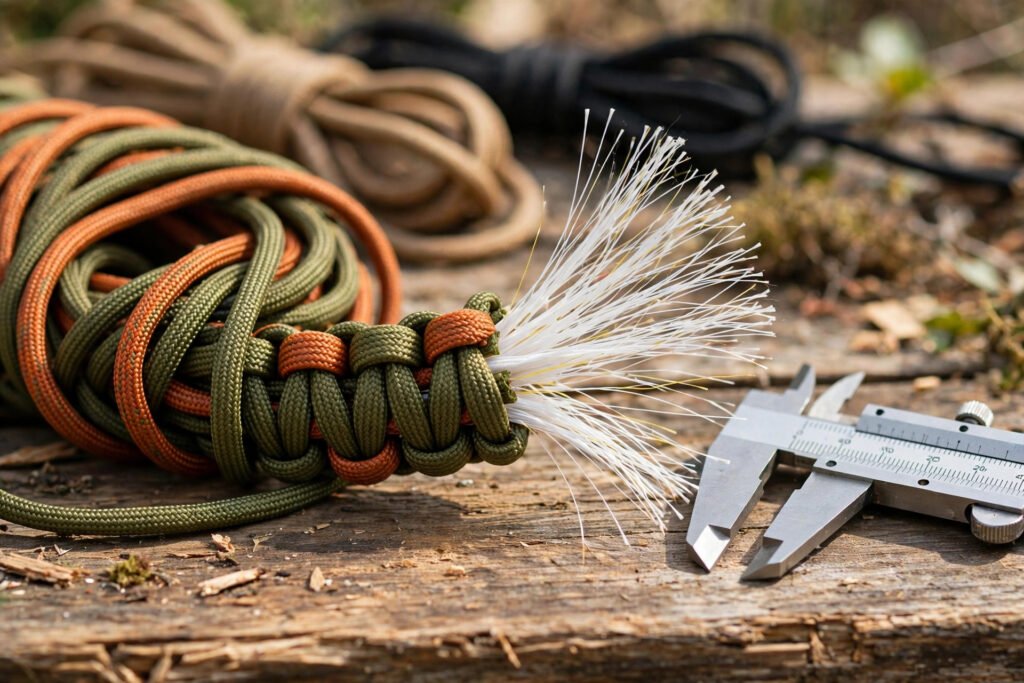
“550” is the most printed number in paracord — and the most misunderstood. It does not mean the cord weighs 550 anything, fits 550 projects, or is safe to climb on. It is a minimum breaking strength, measured under specific test conditions, for one specific construction of nylon cord.
This guide breaks down the real 550 paracord specs: what 550 pounds actually means, the diameter, how many inner strands you should find when you cut it open, how much it stretches, and how to tell whether the cord in your hand matches the specs on its label. No fake mil-spec claims, no inflated numbers — just the specs, and what they mean in practice.
550 paracord specs at a glance
- Minimum breaking strength: 550 lb (249 kg) — a minimum, tested on new, straight cord
- Diameter: about 4 mm (roughly 5/32 inch); genuine mil-spec Type III runs 3.5–4.5 mm
- Construction: braided nylon sheath over 7–9 inner yarns (mil-spec Type III calls for 7–9; most commercial 550 uses 7)
- Inner yarn construction: each inner yarn is itself twisted from 3 smaller strands
- Elongation: roughly 30% stretch at breaking load for nylon cord — it is designed to absorb shock, not to stay rigid
- Weight: about 6.5–7 grams per metre — roughly 0.22 oz per foot, so 100 ft weighs about 22 oz (625 g)
- Melting point: nylon melts around 220°C (428°F), which is why ends seal cleanly with a lighter
- Material: nylon sheath and nylon core on real cord; polyester-sheathed copies behave differently — see the red flags below
If a listing cannot state most of those numbers, that tells you something. Real cord has real specs. Vague cord has adjectives.
What “550” actually means — and what it does not
The 550 figure is the minimum tensile strength in pounds: in a laboratory pull test, a new, undamaged length of Type III cord should not break below 550 lb of straight, steady load.
Three limits matter more than the headline number:
1. Knots cut strength hard
Every knot reduces breaking strength, typically by 30–50% depending on the knot and how cleanly it is tied. A knotted length of honest 550 cord may fail somewhere around 275–385 lb. Plan for the knotted number, never the label number.
2. It is not a working load, and it is not climbing rated
Breaking strength is where cord fails. Working load — what you should actually hang on it day to day — is a fraction of that. A common conservative rule for non-life-safety loads is to stay under 10–20% of breaking strength for repeated use, so roughly 55–110 lb. And plainly: 550 paracord is not rated for climbing, rappelling, or supporting a person. It never was. It was made for parachute suspension lines and general utility use.
3. Age, UV and abrasion lower the number
The 550 lb figure applies to new cord. Sun exposure, grit inside the sheath, repeated bending over a sharp edge, and heat all reduce real strength. Cord that lives on a dashboard or gets dragged over rock should be retired from anything load-bearing long before it looks worn out.
Diameter: why 4 mm matters
At about 4 mm, 550 cord sits in a useful middle: thick enough to grip, tie and weave comfortably, thin enough to pack 100 ft into a small space. Diameter is also a quick honesty check. Cord sold as “550” that measures closer to 3 mm is usually a lighter construction with fewer or thinner inner yarns — it will not meet the strength spec, whatever the label says.
Diameter decides project fit, too. Most bracelet buckles, cord locks and standard weaves are designed around 4 mm cord. Thinner cord weaves loose and sloppy; thicker cord jams in buckles. If you are choosing between thicknesses, our 550 vs 750 paracord comparison walks through when the heavier cord is worth it.
Inside the cord: sheath, inner yarns and the 3-strand twist
Cut a foot of real 550 cord and pull the white core out. You should find:
- 7–9 inner yarns — 7 is standard on commercial cord; mil-spec Type III allows 7–9
- Each yarn twisted from 3 strands — untwist one yarn and it separates into 3; this is a fast field check for genuine construction
- A tightly braided sheath — mil-spec calls for 32 or 36 carrier braiding; in plain terms, the weave should look fine and even, not loose and lacy
Those inner yarns are why paracord is so useful beyond its full diameter. One foot of cord gives you roughly 7 feet of inner yarn for fishing line, snare wire substitutes, sewing thread (use a single untwisted strand), lashing and gear repair. When you plan a project, that math matters — run the full length through the Paracord Length Calculator first, then remember the core multiplies what you actually carry.
For how 550 sits among the other types — 275, 750, Type I and Type II — see paracord types explained.
Stretch: the spec nobody prints in big letters
Nylon paracord stretches — around 30% at breaking load, and noticeably even under everyday loads. That stretch is a feature for its original job: it absorbs the shock when a parachute opens instead of snapping. For utility use it cuts both ways.
Stretch helps when you are lashing a load that shifts, tying down a tarp in wind, or rigging anything that takes sudden jerks. Stretch hurts when you need a line to hold an exact length — a ridge line that sags overnight, or a clothesline that dips. If a job needs low stretch, that is a point in favour of polyester cord, with the trade-off that polyester does not melt-seal or handle shock the same way. Know which behaviour your job needs before you blame the cord.
Mil-spec Type III vs commercial 550
“550” and “mil-spec” are not synonyms. Military specification MIL-C-5040H Type III is what created the 550 category: it sets the 550 lb minimum, the 7–9 yarns, nylon construction, and even a marker yarn inside the sheath identifying the manufacturer. Most cord sold today is commercial cord built to a similar pattern — much of it perfectly good — but it is not inspected to the military standard, and some of it does not meet the numbers at all.
Our guide to mil-spec vs commercial paracord covers the differences in detail. The short version: buy commercial cord happily for bracelets, lanyards and camp use — just buy it from a maker who publishes real specs, and check the cord when it arrives using the tests below.
How to check whether your cord matches its specs
- Count the core. Cut 6 inches, slide the sheath back, count the inner yarns: 7–9 for 550. Fewer means it is not 550 construction.
- Untwist a yarn. Each yarn should separate into 3 twisted strands. Fluffy, untwisted filler is a red flag.
- Check the diameter. Pinch it next to a ruler or measure with calipers: about 4 mm, not 3 mm.
- Weigh 100 ft if you have it. Real nylon 550 runs about 22 oz (625 g) per 100 ft. Much lighter suggests thinner or substitute materials.
- Melt test a cut end. Nylon melts into a clean, hard bead and smells sharp and chemical; it should not drip flaming drops or leave soft, stringy ash like polyester blends can.
None of these tests needs a lab. Together they catch almost every fake. For brand-by-brand guidance on who publishes honest numbers, see our best paracord guide.
How much cord do the specs mean you need?
Specs turn into project math quickly. A standard cobra bracelet uses roughly 1 foot of cord per inch of finished bracelet — about 8–10 ft for most wrists. A king cobra roughly doubles that. A 100 ft hank therefore covers about 10 standard bracelets, with offcuts whose inner yarns are still usable. Our guide to how much paracord do I need? breaks down the common projects, and the Paracord Length Calculator does the arithmetic for your exact wrist and weave.
FAQ
What are the full specs of 550 paracord?
Minimum breaking strength 550 lb, diameter about 4 mm, braided nylon sheath over 7–9 inner yarns (each twisted from 3 strands), roughly 30% elongation at break, about 22 oz per 100 ft, and a nylon melting point around 220°C (428°F). Those numbers together — not the “550” alone — define the cord.
Can 550 paracord really hold 550 pounds?
New, straight, unknotted cord should not break below 550 lb in a steady lab pull. In real use, knots cut that by 30–50%, and age, UV and abrasion cut it further. Treat 55–110 lb as a sensible repeated working range for utility loads, and never use it to support a person.
How many inner strands does real 550 paracord have?
7–9 inner yarns, and each yarn is twisted from 3 smaller strands. Counting 7 yarns is normal for commercial cord. Finding 4–5 loose yarns, or filler that does not untwist into strands, means the cord is not true 550 construction.
Is all 550 paracord mil-spec?
No. Mil-spec refers to cord made and inspected to MIL-C-5040H Type III, which includes the 550 lb minimum plus construction and marker-yarn requirements. Most retail 550 is commercial cord made to a similar pattern. Good commercial cord is fine for most uses — check it with the count, diameter, weight and melt tests in this guide.