
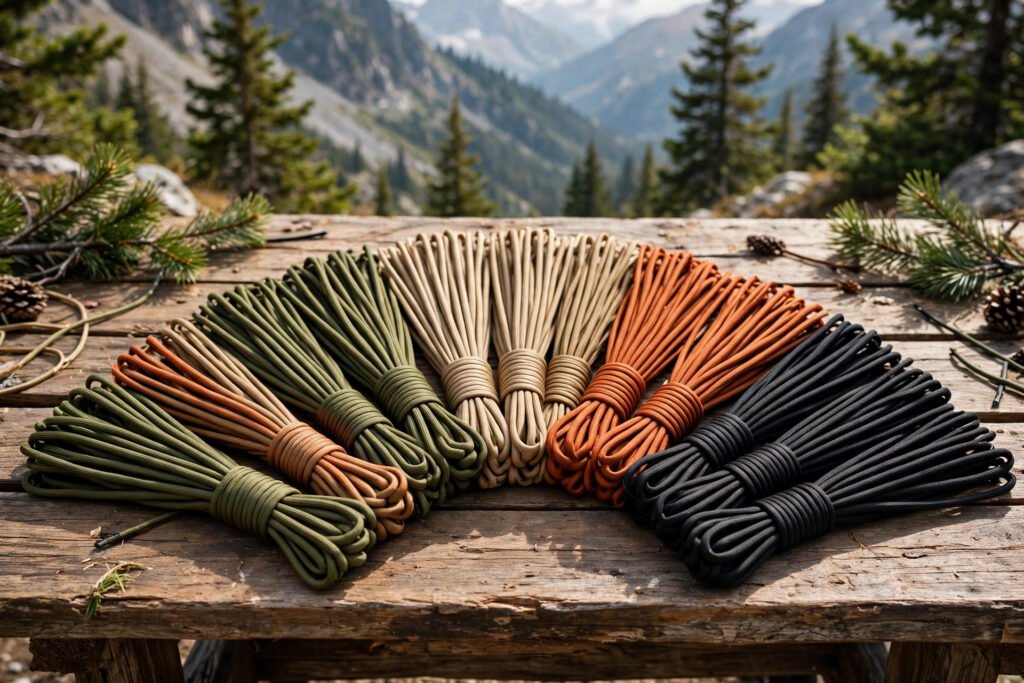
What “Best Paracord” Actually Means
There is no single best paracord. There is only the best cord for a job, and a lot of cord that should never have been sold as 550 in the first place. The label is the problem: anyone can print “550 lb” on a wrapper, and plenty of cheap imports do exactly that while shipping cord with a loose sheath, a thin core, or strands that are not nylon at all.
Real Type III 550 cord has a specific definition. It is rated to a 550 lb minimum break strength, it has 7 inner strands (each itself made of twisted yarns) inside a braided nylon sheath, and it runs about 4 mm in diameter. If the cord in your hand does not match that description, it is not 550 cord, whatever the listing says.
This guide lays out what separates good cord from junk, how to compare strength, abrasion resistance and knot-holding in plain terms, and which cord to buy for bracelets, camping and a survival kit. No hype and no fake ratings — just what to check before you spend money.
The Four Things That Separate Good Cord From Junk
1. A true 7-strand core
The strength of 550 cord lives in its core. Cut a short piece and pull the sheath back: you should find 7 separate inner strands, each a bundle of twisted nylon yarns. Those strands are also the most useful part of the cord in an emergency — they pull out for fishing line, snare wire substitutes, sewing thread, lacing and repair work.
Junk cord cheats here. Some has fewer strands than claimed; some has strands of loose, untwisted filler that looks right until you pull it apart; and some skips strands entirely and stuffs the sheath with polypropylene fluff — decoration cord, not paracord.
2. A tight, dense sheath
The sheath protects the core from abrasion and UV, and it is what your knots actually grip. Good sheath braid is tight and even: run the cord between your fingers and it should feel smooth, round and consistent, with no visible gaps showing the core underneath. A loose, open weave snags, frays early and lets grit work its way in against the strands.
Sheath material matters too. A nylon sheath grips knots and resists abrasion better than a polyester sheath, which feels slicker and tends to slip in friction hitches. Polyester does resist UV and water absorption slightly better, which is why some honest makers sell it — but they label it as polyester. If a listing just says “550 paracord” and the cord feels slippery and melts oddly (see below), be suspicious.
3. Consistent diameter around 4 mm
Type III cord should measure roughly 4 mm across. Cheap cord often runs 3 mm or less, which is a tell that the core and sheath are both undersized. Diameter also affects how a weave behaves: a cobra bracelet woven from thin cord looks flat and loose no matter how carefully you work. If you are sizing cord for a project, run the numbers with our paracord length calculator — thin cord uses slightly less length per weave, but it also produces a flimsier finished piece.
4. Honest ratings
A 550 lb rating is a minimum break strength from a standard test, not a promise that you can hang 550 lb off it. Working loads for any rope should stay a small fraction of break strength — a fifth or less — because knots, abrasion, age and shock loading all cut real strength. Cord sold without any stated type, strand count or material is telling you something. Believe it.
How to Compare: Strength, Abrasion and Knot-Holding
Strength
Start with the type. Type III (550) is the standard for a reason: strong enough for shelter lines, lashing and gear repair, thin enough to weave and carry in quantity. Type IV (750) is stronger and thicker — our 550 vs 750 paracord comparison covers when the upgrade is worth it. Below Type III sit Type II (450 lb) and Type I (95 lb), which are fine for light duty but should never be sold or bought as 550.
Next, confirm the cord actually matches its type: strand count, diameter, nylon construction. A verified-spec cord from a known maker beats an unverified “1000 lb” claim from an anonymous listing every time.
Abrasion resistance
Cord fails by abrasion far more often than by a clean overload. Shelter ridgelines rub on bark; lashings rub on pack frames. What protects the core is sheath density and material. A tight nylon sheath is the benchmark. Check it by dragging a thumbnail across the braid — the weave should not separate or shift easily — and by flexing the cord repeatedly at one point to see whether it fuzzes quickly.
Knot-holding
Knot-holding is where cheap cord quietly fails. Slick polyester sheaths and undersized diameters let knots creep and capsizes happen under cyclic load. Nylon-on-nylon friction is the reference standard: knots in proper 550 dress well, hold, and can still be untied after loading, which matters when the cord has to be reused. For weaves, consistent diameter matters as much as friction; uneven cord makes uneven bracelets.
Picks by Use Case
Rather than a single winner, here is what to look for — and the kind of cord that fits — for the three jobs people buy 550 for most.
Best for bracelets and weaving
Prioritize consistent 4 mm diameter, a tight sheath and colors that match the listing photos. Bracelets are handled constantly, so sheath quality shows fast. Established US makers such as Paracord Planet and Bored Paracord sell weaving-grade cord in hundreds of colors and patterns, and their standard 550 is genuinely 7-strand nylon. For two-color weaves, buy both colors from the same maker — diameters vary slightly between brands, and a mismatched pair weaves unevenly.
Best for camping and general outdoor use
Prioritize nylon construction, honest Type III spec and a maker who publishes test data. Atwood Rope MFG is a long-standing US manufacturer whose 550 is a safe default for ridgelines, guy lines, lashing and clotheslines. Reflective-tracer cord is a legitimate upgrade for tent lines you would rather not trip over at night. Buy 100 ft hanks rather than 50 ft — camp uses eat cord in longer runs than you expect.
Best for a survival kit
Prioritize verified construction above all, because kit cord is insurance. This is the use case where true mil-spec cord earns its price: brands such as TITAN Survival sell cord built to the MIL-C-5040H standard by certified US suppliers, with tested break strengths at or above the 550 minimum. Our guide to mil-spec vs commercial paracord explains how to tell the genuine standard from the marketing phrase. Some survival cord adds useful extras inside the sheath — waterproof fire-starter tinder thread, fishing line and conductive wire in TITAN’s SurvivorCord designs are the well-known examples. Keep 50 to 100 ft in the kit and a hank in the vehicle.
How to Spot Junk Cord in 60 Seconds
You do not need a lab. Five quick checks catch most bad cord:
- Read the label. No type, no strand count, no material listed? Walk away. “Parachute cord style” and “550-style” are admissions, not descriptions.
- Count the strands. Snip an inch, strip the sheath, count and untwist. Seven real strands of twisted yarns, or it is not 550.
- Measure it. Around 4 mm. A 3 mm cord sold as 550 is undersized and under-strength.
- Feel the sheath. Tight, smooth, even. Loose weave, visible core or a slick plastic feel means trouble.
- Burn test (carefully, outdoors). Nylon melts into a hard bead and smells faintly sweet/celery-like; it does not sustain a flame well. Polyester melts with black smoke and a sweet chemical smell; polypropylene melts like candle wax, floats in water and burns readily. A float test helps too: nylon sinks slowly, polypropylene floats.
Price is the last tell. Quality 550 from a real maker does not cost a fortune, but cord priced at a third of every known brand, with a specification-free listing, is priced that way for a reason.
How Much to Buy
For weaving, cord usage depends on the weave and finished size — a cobra bracelet uses roughly a foot of cord per inch of bracelet, and heavier weaves use far more. The paracord length calculator works it out per weave and shows how many projects fit on a spool. As a rule: buy one length class above what you think you need. Cord is cheap, light and keeps forever if stored out of sunlight, and running short mid-project costs more than the extra hank did.
FAQ
Is mil-spec paracord always better than commercial cord?
Not for every job. True mil-spec cord, covered in our mil-spec vs commercial comparison, guarantees tested construction from a certified maker, which matters for survival kits and load-bearing uses. Good commercial Type III from a reputable maker is the same 7-strand, 550 lb design and is perfectly fine for bracelets, crafts and most camp chores — at a lower price.
Can I climb or tow with 550 paracord?
No. 550 lb is a minimum break strength in ideal test conditions, and knots alone can cut a rope’s strength by a third or more. Never use paracord for climbing, rappelling, fall protection, towing vehicles or lifting loads over people. Use rated equipment built for those jobs.
How long does paracord last?
Stored dry, dark and away from chemicals, nylon paracord keeps for many years with little strength loss. In service, UV exposure and abrasion are what wear it out — inspect cord that lives outdoors each season and retire anything with a frayed sheath or exposed, damaged core strands.
What is the difference between 550 cord and 750 cord?
Type IV 750 cord raises the minimum break strength to 750 lb, uses 11 inner strands and runs thicker, around 4.8 mm. It is stronger but bulkier, and overkill for most weaving. The full comparison is in 550 vs 750 paracord.