
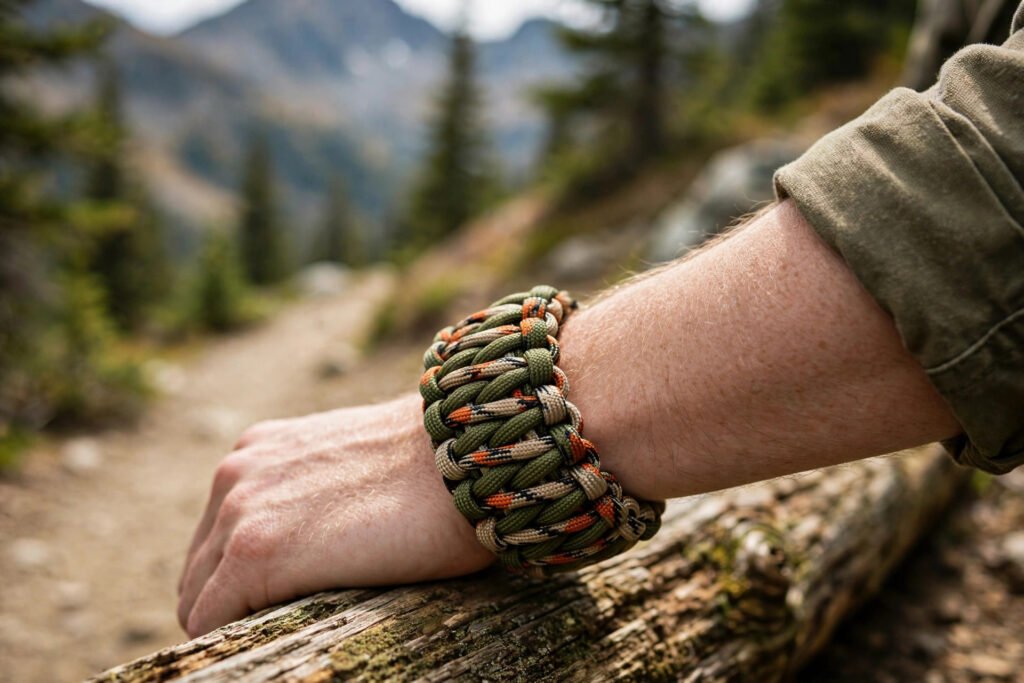
A Bracelet Is Cord First, Gadgets Second
A survival bracelet has one job it can genuinely do: put 8 to 12 feet of usable paracord on your wrist, where it is actually with you when something goes wrong. Everything else — the ferro rod in the buckle, the whistle, the compass — is a bonus that has to survive a simple test: does it work, and does it work without ruining the bracelet as a bracelet?
The market is full of bracelets built backwards: gadget-loaded buckles clipped onto thin, mystery cord that would embarrass a craft kit. This guide works through what each feature is worth, what to avoid, and how to judge the cord itself, so you can pick a bracelet — or decide to make your own — with clear eyes.
What a Survival Bracelet Can and Cannot Do
Set expectations first. Unraveled, a standard cobra-weave bracelet gives you one length of 550 cord: enough for a shelter ridgeline repair, lashing, a tourniquet improvised in a true emergency, bootlaces, or a fishing-line-and-snare source once you pull out the inner strands. The 7 strands inside are often the most valuable part.
It will not give you a climbing rope, a tow line, or a rescue system. And the accessories are backups, not primaries: the tiny ferro rod in a buckle is a last-ditch fire source, not a replacement for the lighter and ferro rod in your kit. A bracelet that understands its own limits is the one worth buying.
The Features That Matter, Ranked
1. The cord itself
Everything starts here, and it is the spec sellers shout about least. Look for:
- Real Type III 550 cord: 7 inner strands, nylon sheath, roughly 4 mm diameter. Thin 3 mm “paracord-style” bracelets hold a fraction of the cord and a fraction of the strength.
- A real weave with real length. A standard cobra weave in a typical wrist size holds about 10–12 ft of cord. King cobra weaves hold more — up to roughly double — at the cost of a thicker, heavier bracelet.
- Honest sizing. The bracelet should be sold by wrist measurement, and the maker should state the approximate cord length per size.
If a listing leads with twelve features and never states strand count or cord length, the cord is the weak point and the seller knows it.
2. The fire starter
Two designs dominate. Ferro rod buckles embed a short ferrocerium rod in one side of the buckle with a small striker (often a metal plate or serrated edge) on the other. They work — a practiced hand can light good tinder with one — but the rod is short, so spark volume is modest, and the striker quality varies wildly. Check what to look for: a rod that sits firmly (a loose rod that pops out is a lost rod), and a striker with a genuinely sharp 90-degree edge rather than a decorative serration.
Fire-starter cord is the alternative: bracelets woven with a strand of tinder thread inside the sheath, sold by TITAN Survival in its SurvivorCord line and as finished bracelets. Unraveled, the tinder strand lights from a ferro rod spark far more readily than scraped natural material. It is a legitimate design, though it only pays off once you unravel the bracelet.
What to avoid: magnesium-chip novelty rods too small to strike, and “fire starter” claims with no visible rod at all — some listings mean the buckle has a flint-colored decoration.
3. The whistle
A whistle is genuinely useful — sound carries farther than a voice and costs no energy — and a whistle buckle adds almost nothing in bulk. Judge it by one criterion: loudness. A properly designed whistle buckle is piercingly loud, in the range of a real emergency whistle. Weak designs produce a thin wheeze you can barely hear across a parking lot. Sellers of the good ones often state a decibel figure (110 dB+ claims are typical for serious designs); sellers of the bad ones change the subject. The whistle should also work wet — most simple pea-less designs do.
4. The compass
Treat buckle compasses as a rough reference, not navigation. Small button compasses are prone to inaccuracy from nearby metal (including the ferro striker) and cheap ones can be off by enough to mislead. If a bracelet includes one, verify it against a known direction before trusting it even loosely, and never let it substitute for a real compass and map in country where getting lost is a serious outcome. A compass buckle is the feature most often present for the product photo rather than for you.
5. Everything else
Scraper blades, fishing kits hidden in buckles, LED lights, “multi-tool” buckles with tiny knife edges — each addition adds failure points and usually subtracts bracelet comfort. A bracelet you stop wearing because it is bulky or catches on sleeves delivers zero feet of cord when it matters. Simple and wearable beats loaded and left in a drawer.
How to Judge Cord Amount
Sellers love to advertise cord length loosely. Work it out yourself:
- A cobra weave uses roughly 1 ft of cord per inch of finished bracelet. A 7.5-inch bracelet therefore holds about 7.5–10 ft once you account for the core strands it is woven around.
- King cobra (a second cobra layer over the first) roughly doubles the cord, which is why those bracelets look and feel chunkier.
- Slim weaves like fishtail hold less — often 5–7 ft in a typical size.
Rather than trusting listing math, use the paracord length calculator to see what any weave and size actually uses. And be skeptical of “up to 16 feet” claims on slim bracelets; the weave arithmetic does not support them.
Making Your Own vs Buying
Making your own bracelet is a genuinely good option, and it is how most paracord hobbyists start. You control the cord — buy verified 550 from a reputable maker like Atwood Rope or Paracord Planet — you pick a quality whistle/ferro buckle separately, and you size it exactly to your wrist. Our step-by-step cobra bracelet tutorial walks the whole build, and the buckle style it uses can be swapped for a whistle or ferro buckle of the same width.
Buy a finished bracelet when you want it done today, when the maker uses named, verified cord (TITAN Survival’s bracelets are the standard example — mil-spec cord, real ferro and whistle buckles), or when you are outfitting several people at once. The price premium over the raw materials is modest for the honest brands.
Whichever route you take, the bracelet belongs in a system: it complements the cordage and fire kit in your bug-out bag checklist, it does not replace them.
What to Avoid, in One List
- Unspecified “paracord-style” cord with no strand count, type or material.
- Cord lengths that violate weave math (“20 feet!” on a slim single weave).
- Compass-led listings where the compass is the headline and the cord is a footnote.
- Buckles with so many gadgets the bracelet becomes uncomfortable — you will stop wearing it.
- Any bracelet marketed for climbing, rappelling or rescue loads. There is no such bracelet.
FAQ
How much cord is in a survival bracelet?
Typically 8–12 ft for a standard cobra weave in an average wrist size, and up to roughly double for a king cobra at the cost of bulk. Slim weaves hold less. The paracord length calculator shows the usage for your weave and size.
Do the ferro rod buckles actually work?
Yes, within limits. A real ferro rod in a buckle, paired with a sharp striker and fine, dry tinder, will start a fire — it is a genuine backup. It produces fewer sparks than a full-size rod and takes practice, so test yours at home rather than discovering its limits in the field.
Is a compass bracelet accurate enough for navigation?
No. Buckle compasses are a rough directional reference at best and can be thrown off by nearby metal. Use one to sanity-check a direction, never as your primary navigation tool.
Should a survival bracelet be part of my bug-out bag?
It is a wearable supplement, not a bag item — its whole value is being on your wrist when you are separated from your gear. Keep proper cordage and fire-starting in the bag itself; our bug-out bag checklist covers quantities.