
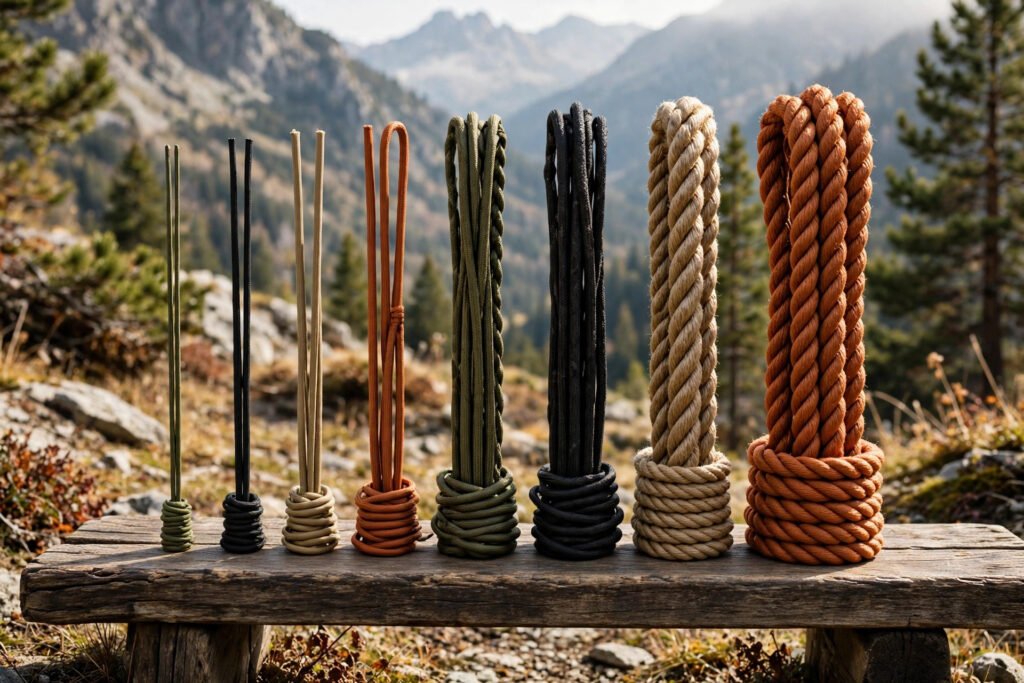
Paracord is not one product. It is a family of nylon cords built to a military specification, and the type number tells you exactly what you are holding: how strong it is, how thick it is, and how many inner strands are packed inside the sheath. Once you understand the four common types, the marketing noise disappears. You stop buying cord because the listing said “military grade” and start buying the right cord for the job.
This is the reference page for the whole system. If you are stocking a kit, start here, then narrow down with our guide to the best paracord and the head-to-head on 550 vs 750 paracord.
Where paracord comes from
Paracord — parachute cord — began as the suspension lines of World War II parachutes. The original specification, MIL-C-5040, set construction standards for the nylon cordage used to connect a paratrooper’s harness to the canopy. Soldiers quickly discovered the cord was useful for everything else, too: lashing gear, rigging shelters, tying loads, and, once the inner strands were pulled out, sewing, fishing, and snaring.
The current specification is MIL-C-5040H, and it defines six types, from Type IA up to Type IV. Four of them matter for civilian use: Type I, Type II, Type III, and Type IV. Each type is a complete construction standard, not just a strength rating. The spec controls the sheath weave, the number and construction of the inner strands (called yarns or strands in the trade, each itself made of twisted nylon fibers), the minimum break strength, and even the elongation. When a seller claims “mil-spec,” this document is what they are claiming to meet — and most commercial cord does not, which is fine as long as you know what you actually bought.
The spec table
| Type | Minimum break strength | Inner strands | Approx. diameter | Character |
|---|---|---|---|---|
| Type I | 95 lb | 1 | ~1.6 mm | Light utility line |
| Type II | 275 lb | 4–6 (commercial varies) | ~3 mm | Middleweight cord |
| Type III | 550 lb | 7 | ~4 mm | The standard paracord |
| Type IV | 750 lb | 11 | ~4.8 mm | Heavy-duty cord |
Two cautions about the table. First, break strength is a minimum for cord built to the genuine specification, tested new and dry. Knots reduce any cord’s strength substantially — assume a knot costs you a third to half of the rating. Second, commercial cord sold by type name is not always built to spec. A “550” cord with flat, tape-like fillers instead of twisted inner strands is not Type III in any meaningful sense, whatever the label says.
Type I — 95 lb
Type I is the lightweight of the family: roughly 95 lb break strength with a single inner strand inside the sheath, about 1.6 mm across. Its un-gutted sibling, Type IA, has no inner strand at all.
Nobody weaves bracelets from Type I, and it has no business holding anything heavy. Its real role is as a compact utility line: lanyards, dummy cords for small gear, guy-line adjusters on ultralight shelters, zipper pulls, and craft work. Gut it and the single inner strand, itself made of twisted yarns, becomes light thread for repairs. Think of Type I as the cord you carry in quantity because it weighs almost nothing, not the cord you trust with a load.
Type II — 275 lb
Type II sits in the gap most people skip over: around 275 lb break strength and roughly 3 mm diameter. True spec Type II is less common on shelves than Type III, and much of what is sold as “275 paracord” is a commercial construction in the same spirit.
That is a shame, because 275 cord is arguably the sweet spot for everyday carry and camp tasks. It ties smaller, cleaner knots than 550, packs half the bulk for the same length, and is still far stronger than most camp jobs require — hanging a lantern, rigging a tarp ridgeline with a safety margin, lashing a load to a pack. If 550 feels like overkill for your kit, this is your cord.
Type III — 550 lb, the standard
Type III is what the world means by “paracord”: 550 lb minimum break strength, seven inner strands, roughly 4 mm diameter. It became the default for three reasons. It is strong enough for serious lashing and emergency use, it is still supple enough to knot and weave easily, and the seven inner strands make it a multi-tool in itself.
Those inner strands deserve attention, because they are half the reason paracord exists in a survival kit. Pull one out and you have a strong twisted yarn that works as sewing thread for gear repair, fishing line, a snare, lashing for small items, or floss-grade cordage for a dozen improvised fixes. Seven strands per length means one 20-foot hank of 550 carries 140 feet of light line inside it.
Type III is the right default for bracelets (a cobra weave uses about 1 foot of cord per finished inch), dog leashes and collars, shelter building, tow and tie-down work within reason, and general kit cordage. If you buy one type, buy this one — but buy it from a maker who states the construction honestly. For help sorting the real from the dressed-up, see our best paracord picks.
Type IV — 750 lb
Type IV raises the rating to 750 lb with eleven inner strands and a diameter just under 5 mm. It is noticeably stiffer and bulkier than 550, and the extra strands make it the best of the family for gutting: eleven strands per length is a lot of fishing line and thread.
The honest case for 750 is narrow but real. Choose it when working loads are genuinely high — heavy lashing, hauling, vehicle kits, boat kits — or when you specifically want maximum inner-strand yield per foot carried. Skip it for bracelets and fine work: the bulk fights you, knots dress less cleanly, and most projects gain nothing from strength they will never approach. The full comparison, including cost per foot, is in 550 vs 750 paracord.
Which type for which job
- Bracelets, key fobs, woven gear: Type III. Nothing else weaves as well at that size.
- Everyday carry and light camp cordage: Type II (275), or Type III if you only carry one.
- Survival kit core cord: Type III, with an extra length you are willing to gut for strands.
- Heavy lashing, hauling, vehicle and boat kits: Type IV, accepting the bulk.
- Ultralight and bulk utility line: Type I, plus gutted strands for thread and fishing line.
Whatever type you choose, plan lengths before you cut. Our Paracord Length Calculator works out the cut length for common weaves so you do not waste cord or run short mid-project.
A word on “mil-spec” claims
Genuine MIL-C-5040H cord is made by a small number of certified manufacturers, largely for government contracts. Most cord in retail — including plenty of good cord — is commercial Type III construction: same diameter, same seven-strand layout, similar strength, but not certified to the specification. That is not a scandal. What matters is honest construction: a woven nylon sheath, twisted nylon inner strands (not flat filler), and strength claims a maker will stand behind. Buy construction, not adjectives.
FAQ
Is 550 paracord strong enough to climb on?
No. Paracord of any type is not life-safety rope. It has no rated working load for body weight, it stretches, and knots weaken it further. Use rated climbing rope for anything involving a person.
Can I use the inner strands on their own?
Yes — that is one of paracord’s design strengths. The inner strands are twisted nylon yarns that work as sewing thread, fishing line, snare wire substitute, and light lashing. A single strand is not rated anywhere near 550 lb, so reserve strands for light work.
What is the difference between 550 and “tactical” 750 cord?
“Tactical” is a marketing word, not a type. Real Type IV is defined by MIL-C-5040H: 750 lb minimum break strength and eleven inner strands. If a 750 listing does not state its strand count and construction, treat the number as decoration.
Which type should a beginner buy first?
A 100-foot hank of honest commercial Type III (550). It covers nearly every project in our tutorials, weaves cleanly, and the leftover strands will teach you why the inner cordage matters.