
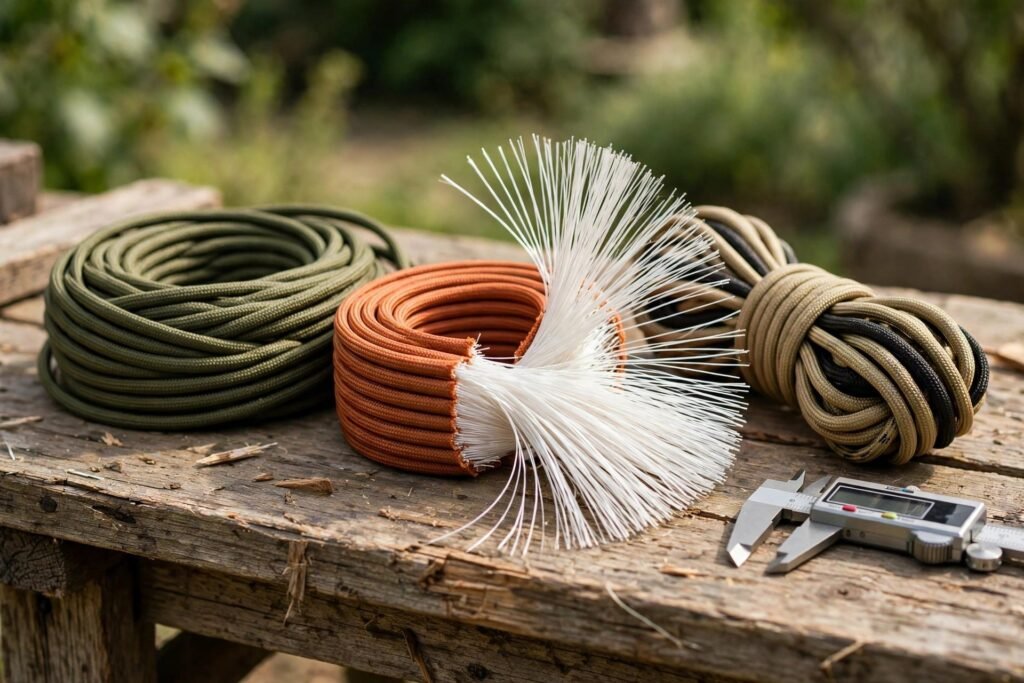
750 paracord is the step up from 550 that a lot of people buy for the bigger number — and then use exactly like 550, in a thicker, heavier, harder-to-weave form. The number is real, but it only helps if you understand what the 750 paracord specs actually change: diameter, core strands, weight, handling, and the projects the cord is honestly suited to.
This guide lays out the specs plainly, compares them directly with 550, and states the limits honestly. A higher breaking strength on the label does not make any cord a climbing rope, a tow strap, or a safety line. It makes it a stronger utility cord — used within utility-cord limits.
750 paracord specs at a glance
| Spec | 750 / Type IV paracord | What it means in practice |
|---|---|---|
| Minimum breaking strength | 750 lb (about 340 kg) | Static lab minimum for true Type IV cord — not a working load |
| Diameter | About 5 mm (roughly 3/16 inch) | Noticeably thicker in the hand than 4 mm 550 cord |
| Core strands | 11 inner strands in true Type IV | More core material is where the extra strength comes from |
| Sheath | Braided nylon sheath, typically 32-strand braid | Abrasion protection for the core, same job as on 550 |
| Construction | Kernmantle — core carries the load, sheath protects it | Cut the sheath open and the strands inside do the work |
| Weight | Roughly 1.5 times the weight of 550 per foot | A 100 ft hank is a real chunk of a pack, not a pocket item |
| Stretch | Nylon elongation, broadly similar in character to 550 | It gives under shock load — helpful for lashing, bad for precision rigging |
One warning before any other number: commercial cord sold as “750” is not automatically certified Type IV cord. Strand counts on commercial 750 vary — 9, 10 and 11-strand cores all appear on the market. If a listing will not state its strand count and diameter, treat the 750 figure as marketing, not a spec. Our guide to 550 paracord specs explains the same label problem on the smaller cord, and the red flags are identical.
Breaking strength: 750 lb means less than you think
The 750 lb figure is a minimum breaking strength: the load at which new, undamaged cord fails in a straight static pull under test conditions. It is not a working load, not a rating for a knotted line, and not a promise about old, wet, sun-aged or abraded cord.
Three things cut that number down fast in real use. Knots reduce cord strength substantially — a tight bend is a stress concentration, and a knotted 750 line should never be planned as a 750 lb line. Dynamic loads multiply force: a load that drops even a short distance before the cord catches it can spike well past its static weight. And damage is invisible from a distance — a sheath that looks fine can hide a nicked core.
The honest working-load habit
For general utility work, experienced cord users keep planned loads to a small fraction of the breaking strength — a tenth is a common conservative habit for anything that matters, which puts sensible planned loads for 750 cord in the region of 75 lb, not 750. That sounds low until you remember what the cord is for: lashing, guy lines, haul lines for light gear, clotheslines, shelter rigging and repairs. For all of those, 75 lb of honest capacity is plenty. For anything involving a person’s weight or a vehicle, the answer is not a bigger paracord — it is properly rated equipment made for that job.
Diameter and core: where the extra strength lives
True Type IV cord is about 5 mm across, against about 4 mm for Type III 550 cord. That single millimetre sounds trivial and is not. Cross-section grows with the square of diameter, so the thicker cord carries meaningfully more nylon — most of it in the core, which grows from 7 inner strands on standard 550 to 11 inner strands on true 750.
Those inner strands are still useful on their own. Pulled out of the sheath, individual strands serve as sewing thread for heavy fabric, fishing line in a survival context, lashing for small repairs, and trip lines. Eleven strands give you more of that secondary material per foot than seven — a genuine, if modest, advantage for a survival kit, where one length of cord is really several tools stacked inside a sheath.
The thicker diameter also changes handling. 750 cord ties bulkier knots, needs larger cord locks and buckle slots, and does not sit happily in hardware sized for 550. Check any buckle, tensioner or grommet against 5 mm cord before you plan a build around it.
750 vs 550: the specs side by side
| 550 (Type III) | 750 (Type IV) | |
|---|---|---|
| Minimum breaking strength | 550 lb | 750 lb |
| Diameter | About 4 mm | About 5 mm |
| Core strands | 7 | 11 (true Type IV) |
| Weave feel | Flat, flexible, easy to tighten | Rounder, stiffer, bulkier stitches |
| Best projects | Bracelets, lanyards, most wraps | Belts, leashes, heavy lashing, haul lines |
| Kit weight | Light — easy to carry 50–100 ft | Heavier — carry it on purpose, not by default |
Our full head-to-head, 550 vs 750 paracord, covers choosing between them project by project. The short version: the strength difference rarely decides it. Diameter, weight and how the cord behaves in your hands decide it. And if the thinner end of the range is in play for fine work, our 550 vs 275 paracord comparison covers the other direction. The paracord types explained guide puts 750 in the full family picture, from 95 cord up.
What 750 cord is genuinely good for
- Heavy lashing and shelter rigging: ridge lines and frame lashing where knots will be loaded for days and a thicker cord is kinder to hands when tensioning.
- Haul lines for light gear: raising a pack or a food bag, within the honest working-load habit above — never a person.
- Belts and dog leashes: projects where the extra width reads as substance, not bulk. A woven 750 belt feels like a belt.
- Handle wraps: on tools and grips where a 4 mm wrap feels thin, 5 mm cord builds diameter faster with fewer passes.
- A vehicle or base-camp kit: where weight does not matter and one hank has to cover everything from tarps to repairs.
Where 750 is the wrong choice
Bracelets are the big one. A cobra bracelet woven in 750 comes out thick, round and stiff; most wrists wear a 550 bracelet better, and most bracelet hardware is sized for it. Fine weaving suffers too — tight patterns that rely on cord flattening into place fight you in 5 mm. Backpacking is the other clear case: if every gram is planned, carrying 750 “just in case” spends real weight on strength you will almost certainly never use, when 550 covers the same jobs lighter. Our guide to the best paracord and to cordage for survival kits both land in the same place: match the cord to the kit, not to the biggest number on the shelf.
How much 750 cord do you need?
Weave rates change with diameter. A cobra weave in 750 uses more cord per finished inch than the same weave in 550 — plan roughly 1.1 to 1.3 feet of cord per inch of finished length as a starting estimate, against about 1 foot per inch for 550, and expect wider variation between weavers because the stiffer cord responds more to tension. Belts and leashes scale that up quickly, which is why guessing is expensive in this cord.
Before you cut a long length, run your project through the Paracord Length Calculator, then add a margin for the thicker cord and your first attempt at a new size. Our paracord length chart gives the 550 baselines to adjust from, and how much paracord do I need? covers non-woven quantities — guy lines, lashing and kit lengths — where the same honest-margin habit applies.
Buying 750 without getting fooled
- Strand count stated: true Type IV has 11 inner strands. A listing that hides the count is telling you something.
- Diameter stated: about 5 mm. Cord sold as 750 at 4 mm is 550 with a new label.
- Material stated: nylon core and sheath for real paracord behaviour. Polyester-core “paracord” stretches and handles differently.
- Mil-spec claims: genuine military Type IV follows the mil-C-5040 specification; most commercial cord is “mil-spec style.” Our mil-spec vs commercial paracord guide explains what that wording does and does not prove — commercial cord can be excellent, as long as its own stated specs are honest.
FAQ
Is 750 paracord stronger than 550 paracord?
Yes, on paper and in construction: 750 lb minimum breaking strength against 550 lb, about 5 mm diameter against 4 mm, and 11 core strands against 7 in true Type IV cord. In real knotted, aged or dynamic use both numbers fall substantially, which is why planned working loads should stay a small fraction of either figure.
Can you make bracelets with 750 paracord?
You can, and some people like the chunky result, but most bracelet patterns and buckles are designed around 4 mm 550 cord. A 750 bracelet comes out thicker, rounder and stiffer, uses more cord per inch, and may not fit standard buckle slots. For a first bracelet, 550 is the easier and better-fitting choice.
Is all 750 paracord mil-spec Type IV?
No. Type IV is the military designation behind the 750 lb figure, but most cord sold as 750 is commercial cord built to resemble it, with strand counts that vary from 9 to 11. Check the stated strand count and diameter before buying, and treat an unstated spec as an unknown spec.
How much 750 paracord should I carry in a kit?
For a vehicle or base-camp kit, 50 feet covers most lashing, rigging and repair jobs with length to spare. For a carried pack, most people are better served by 50–100 feet of lighter 550 cord covering the same jobs — carry 750 on purpose for a planned heavy job, not as a default.