
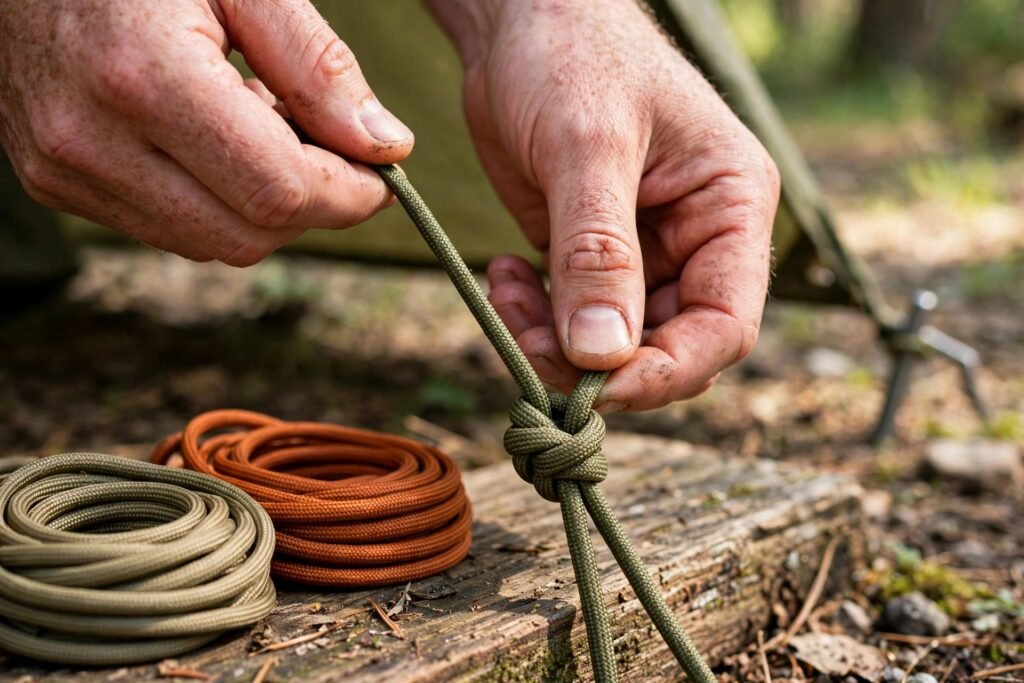
A tarp guy line is useless if it sags when the wind changes. Too loose and the tarp flaps and pools rain. Too tight with a fixed knot and you must retie it every time the cord stretches. The taut-line hitch solves that: it slides when you push it, and grips when the line is loaded.
This guide teaches how to tie a taut-line hitch with 550 paracord, step by step, with the exact cord lengths for tarp and tent lines, the mistakes that make it slip, and the limits you need to respect. No fake mil-spec claims and no life-safety shortcuts. Just an adjustable knot that earns its place on every shelter line.
What the Taut-Line Hitch Actually Does
The taut-line hitch is an adjustable friction hitch. You tie it around its own standing line, forming a loop you can slide up or down by hand to change tension. When you let go and the load comes on — wind on a tarp, weight on a clothesline — the wraps bind and hold their position.
That slide-and-grip behavior is the whole point. Nylon paracord stretches under load, roughly 15 to 30 percent depending on construction, and a line tight at sunset can be loose by midnight. With a taut-line hitch you do not retie anything — grab the hitch, slide it a few inches, and the line is tight again. It holds by friction, so it depends on clean, well-dressed wraps. Tied well in 550 cord it is reliable for guy lines and tent lines; tied sloppily in slick cord, it will creep.
What You Need and How Much Cord to Use
Use real 550 paracord for most shelter work: about 4mm diameter, 7 inner strands in typical quality cord, and a stated minimum breaking strength of 550 pounds for true-rated cord. Read 550 paracord specs for the full breakdown of diameter, strands, and stretch. For light guy lines, 275 cord also works and makes a smaller, neater hitch, but 550 grips better and is easier to handle with cold or gloved hands.
For a taut-line hitch, the line itself is the cord — you are not adding a separate piece. You need enough length for the span, the anchor wrap, and the hitch itself, plus working tail to slide it.
| Job | Line length to start with | Notes |
|---|---|---|
| Tarp corner guy line | 6 to 8 feet | Stake 3 to 4 feet from the corner, hitch near the tarp end |
| Tent guy line replacement | 6 feet | Match the other lines so tension stays even |
| Clothesline between two trees | Span plus 4 feet | One fixed end, one taut-line end for re-tensioning |
| Tarp ridgeline adjustment loop | 25 to 30 feet for the ridgeline | Use hitches on the tarp attachment points, not the main span load |
| Bear-bag or food-hang adjustment | Span plus 5 feet | Light loads only; check local rules for food storage |
Run your span through our Paracord Length Calculator before you cut, and cross-check the paracord length chart. For broader planning for a kit or shelter setup, see how much paracord do I need. Cutting a foot long beats retying a line that is 6 inches short in the rain.
How to Tie a Taut-Line Hitch with Paracord: Step by Step
Step 1: Anchor the far end first
Fix one end of the line to your stake, tree, or tarp corner — whichever end will not move. The taut-line hitch goes at the adjustable end. Pick one layout and keep it consistent on all corners so you adjust them the same way in the dark.
Step 2: Wrap the working end around the standing line — first two wraps inside
Bring the working end around the standing line and wrap it twice around, with both wraps going inside the loop you are forming, moving toward the anchor direction. Keep the wraps snug and side by side, not overlapping. These first two wraps do most of the gripping.
Step 3: Add one wrap outside
Cross over the first wraps and make one more wrap around the standing line on the other side, farther from the loop. This third wrap locks the first two in place. You should now have two wraps on one side of the crossing point and one wrap on the other — that 2-and-1 pattern is the classic taut-line hitch.
Step 4: Dress it tight and neat
Pull the working end to snug all three wraps down, then slide and tidy them so they sit parallel with no twists or gaps. Dressing is not cosmetic. A twisted wrap has half the contact area, and contact area is what creates the friction that holds the hitch. Take the extra five seconds.
Step 5: Test the slide, then test the grip
Grab the hitch itself — the bundle of wraps, not the free tail — and slide it along the standing line. It should move with firm hand pressure. Then let go and pull on the loop: it should stop and hold. If it slides under load, re-dress it and check the first two wraps are on the correct side. If it will not slide, loosen twisted wraps and test again.
Step 6: Leave a usable tail
Leave at least 4 to 6 inches of tail beyond the hitch. A short tail can work itself through under repeated sliding. For lines that will stay up for days, check the tail and the hitch position once a day.
Best Uses for a Paracord Taut-Line Hitch
- Tarp guy lines: the classic use. Tighten after pitching, re-tighten after the nylon stretches or the wind shifts. This is one of the most practical paracord uses in camp.
- Tent guy lines: replace lost adjusters with a hitch tied directly in the cord — no hardware to lose.
- Clotheslines: slide the hitch to take out sag as wet clothes add weight.
- Shelter lines in a bug out bag: the same 50-foot cord setup described in paracord for a bug out bag relies on adjustable lines for a fast tarp pitch.
- Light lashings that need adjusting: bundle lines and gear ties where you expect to loosen and retighten, rather than a fixed knot you must untie.
For maximum tension on a ridgeline or a vehicle load, a different tool is better: the trucker’s hitch gives mechanical advantage the taut-line hitch cannot. Use the taut-line for adjustment, the trucker’s hitch for hard cinching, and do not ask one knot to do both jobs.
Common Mistakes That Make It Slip
The wraps are reversed. If the single wrap ends up on the wrong side or the first two wraps go outside instead of inside, the hitch loses its grip pattern. If it slips on the first test, untie it fully and rebuild the 2-and-1 pattern rather than adding random extra wraps.
The wraps are not dressed. Overlapping, twisted, or gappy wraps are the number one cause of creep. Snug, parallel wraps hold; messy wraps slide.
Slick or cheap cord. Glossy no-name cord with a loose sheath can slip inside its own hitch. If the sheath bunches when you slide it, that cord is a poor choice for friction hitches — construction matters as much as the rating, as our guide to best cordage for survival kits explains.
Loading it at a sharp angle. The hitch grips best when the load pulls in line with the standing line. A hard sideways pull twists the wraps open. Set your stake and line angle so the pull stays straight.
Expecting it to hold a heavy load. A taut-line hitch is a friction adjuster for light lines. Under a heavy, jerking load it will creep by design of physics, not by failure of your tying. Switch to a fixed knot or a trucker’s hitch for heavier work.
Limits: What a Taut-Line Hitch Must Never Do
Be plain: never use a taut-line hitch in paracord for climbing, hoisting a person, or any job where a slip would injure someone. It is designed to move under hand pressure — that adjustability is exactly why it must never be a life-safety knot. Check shelter lines after wind and rain, and replace cord with a cut or heavily fuzzed sheath where the hitch sits, because damaged sheath changes the friction it depends on.
A 10-Minute Practice Drill
Tie it five times on a chair leg or fence rail before you need it in camp. Aim for a clean 2-and-1 pattern you can tie without looking by the fifth try. Most people get under 60 seconds once wrap direction becomes habit. Keep two pre-cut 8-foot guy lines with the hitch already tied in your tarp kit, and pitching in wind becomes slide-and-done.
FAQ
How many wraps does a taut-line hitch have?
Three wraps in the classic form: two inside the loop, then one outside on the other side of the crossing point. That 2-and-1 pattern lets it slide when pushed and grip when loaded. Fix your dressing first — extra wraps rarely fix a messy hitch.
Why does my taut-line hitch keep slipping?
Almost always the wraps: reversed, twisted, or not dressed snug and parallel. Slick or loose-sheath cord is the second most common cause. Rebuild the 2-and-1 pattern, dress it tight, test the grip before you walk away, and use a different cord if the sheath bunches when you slide it.
Can I tie a taut-line hitch with 275 paracord?
Yes, and 275 makes a compact hitch that works well for light tarp and tent guy lines. 550 cord is easier to grip, dress, and slide with cold hands, and it holds friction better on larger lines. Match the cord to the line you are adjusting — do not tie a 275 hitch around a 550 standing line and expect even friction.
What is the difference between a taut-line hitch and a trucker’s hitch?
A taut-line hitch adjusts tension by sliding along its own line and is best for guy lines and light shelter lines. A trucker’s hitch creates mechanical advantage — about 3 to 1 in theory — to cinch a load far tighter, then locks off. Use the taut-line for adjustable lines, the trucker’s hitch for hard tensioning.