
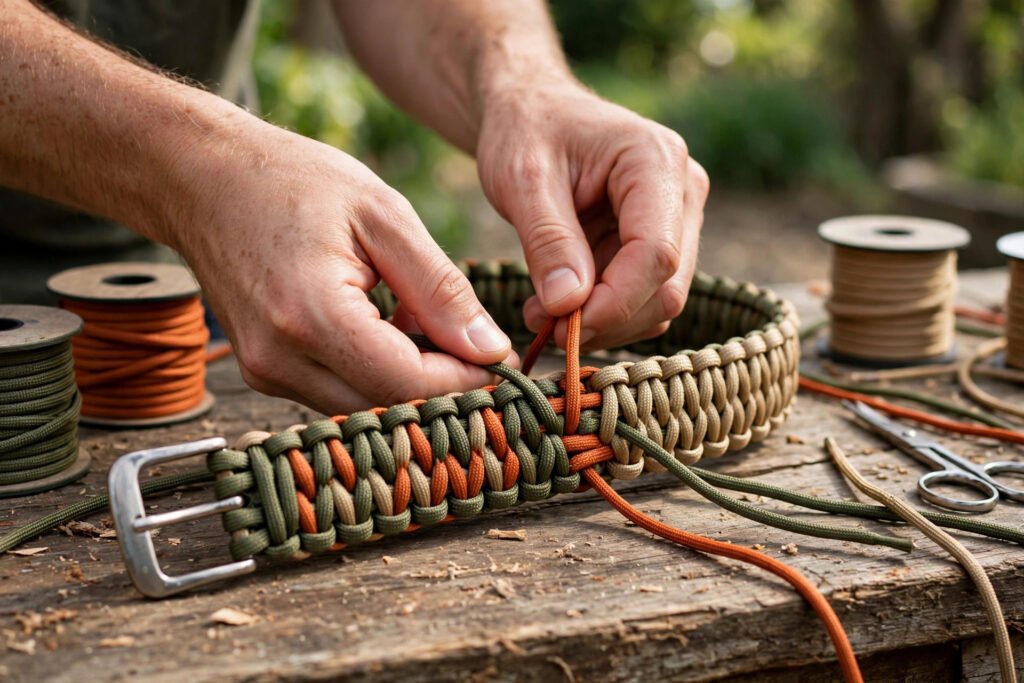
A paracord belt is the biggest wearable cord project most people will ever make — and that is exactly why it is worth doing right. A bracelet holds 8 to 12 feet of cord. A finished belt holds 80 to 120 feet, depending on your waist and weave. That is real, usable cord you carry every day without packing anything extra.
It is also a long project — plan on several hours. This guide on how to make a paracord belt covers the honest numbers first, then the step-by-step weave, so you do not run out of cord at 30 inches.
What You Need to Make a Paracord Belt
You do not need a workshop. You need cord, a buckle, and patience.
- 550 paracord: 80 to 120 feet for most adult waists — see the chart below. One colour is easiest for a first belt.
- Belt buckle: A 1.25-inch or 1.5-inch frame buckle with a prong. Its width sets the belt width, so buy it before the cord.
- Scissors or a sharp knife: For clean cuts before melting.
- Lighter: To melt and seal every cut end.
- Tape measure: A soft tailor’s tape is best for waist sizing.
- Optional: A clamp or jig to hold the buckle steady, and a fid for tucking final ends.
Use real 550 cord. As covered in our guide to 550 paracord specs, genuine 550 is about 4mm with 7 inner strands and a 550-pound minimum break strength for a single straight length. Thin craft cord stretches and frays.
How Much Paracord Do You Need for a Belt?
Most first belts fail in the maths, not the weave. A cobra weave eats roughly 10 to 12 feet of cord for every foot of finished belt, and king cobra eats more.
Use these starting figures for a cobra-weave belt, then confirm your exact project with the Paracord Length Calculator before you cut anything:
| Finished belt length | Cobra weave (approx.) | King cobra (approx.) |
|---|---|---|
| 32 inches | 80 feet | 125 feet |
| 36 inches | 90 feet | 140 feet |
| 40 inches | 100 feet | 155 feet |
| 44 inches | 110 feet | 170 feet |
Those are estimates — tension changes the rate. Always cut 10 to 15 percent more than the chart says. Extra cord trims off in seconds; running short at inch 34 means unpicking hours of work.
For other projects, see our paracord length chart and how much paracord do I need.
Step 1: Measure and Size the Belt Correctly
Do not size a belt from your trouser label. A size 34 trouser usually needs a 36- to 38-inch belt.
Measure a belt you already wear, from the buckle fold to the hole you use. No belt? Wrap a tape around your waist over trousers and add 4 to 6 inches for the fold-over and tail. Write the finished length down — everything else depends on it.
Cut the core strands
Most belt weaves run over 4 core strands. Cut 2 lengths, each about 12 inches longer than your finished belt, and fold each in half. Those folds form the loops that attach to the buckle.
Step 2: Choose Your Weave — Cobra, King Cobra, or Double-Wide
Cobra (Solomon bar): The right first choice. About 1 inch wide over 4 cores with 550 cord, flat, flexible, and the fastest to weave. It also unravels fastest in an emergency, which matters if the belt is partly survival gear.
King cobra: A second cobra layer over the first. About 1.25 inches wide and roughly 50 percent more cord, but stiffer and slower to unpick. It softens with wear.
Double cobra / wide weaves: Six or more cores, up to 1.5 inches wide. Save these for your second belt. Make your first a plain cobra — you will finish it and learn your tension.
Step 3: Attach the Cord to the Buckle
Push the folded loops of your 2 core cords through the buckle bar and pull the loose ends through the loops — a cow hitch (lark’s head) on each side. Pull them snug and even. The 4 core strands should hang parallel, the same length, with no twists.
Clamp or tape the buckle to a table edge. You will pull against this anchor hundreds of times; if it moves, your width will wander.
Find the centre of your long weaving cord, place it behind the cores just below the buckle, with equal lengths left and right. Those are your working ends.
Step 4: Weave the Belt, Row by Row
The cobra stitch
Take the left working cord and cross it over the cores, forming a loop on the left. Take the right working cord, pass it over the left cord’s tail, behind the cores, and up through the left loop. Pull both ends evenly to snug the knot up to the previous row. Now mirror it: right cord over the cores, left cord over that tail, behind the cores, and up through the right loop. Pull snug. That left-right pair is one full cobra cycle.
Repeat. Hundreds of times. A 36-inch belt is roughly 200 to 220 cobra cycles.
Keep the width and tension even
After every 4 or 5 cycles, push the rows tight and check the width — about 1 inch for cobra. Narrowing means you are pulling tighter as you tire; wavy and wide means too loose. Fix it in the last few rows, not at the end. Work in sessions: 3 to 5 hours total over two evenings is normal.
Using two colours
Join the colours at the centre before you start — melt both ends, press together, roll flat. Keep the same colour on the same side throughout, and write your pattern down.
Halfway through, re-check your remaining cord against the Paracord Length Calculator. Measure how many inches you have finished and how much cord you have used. That mid-project check is the difference between a small adjustment and a ruined belt.
Step 5: Finish the End and Add Holes
Weave until you are about 1 inch short of your finished length. For a simple frame buckle, the woven end is the tail — no second buckle piece is needed.
Finish every loose end the clean way: trim to about a quarter inch, melt, and press flat, or tuck the ends back under the last 3 or 4 rows with a fid before trimming. Our full method is in how to finish paracord bracelet ends — the same melt, trim and tuck applies, just on a larger piece.
Punching belt holes
Mark 5 holes, 1 inch apart, starting at your measured wear position. Push a heated punch or awl through the centre of the weave — melting seals the nylon so the hole does not fray. Test the prong fit after the first hole, then try the belt on: it should sit snug on the middle hole.
Honest Limits: What a Paracord Belt Can and Cannot Do
A paracord belt is useful emergency cord, not a rescue rope. Unweave a cobra belt and you recover most of its 80 to 100-plus feet, plus inner strands if you gut it — enough for shelter lashings, a clothesline, and camp jobs like those in our paracord crafts for beginners roundup. But unweaving a king cobra can take 20 to 30 minutes, and a worn belt should never be trusted for climbing, towing, or holding a person’s weight. Wear, UV, and hidden damage change its strength in ways you cannot inspect.
Care: Making Your Belt Last
Wash in warm water with mild soap, rinse, and air-dry out of direct sun. Check the buckle fold and holes every few months — those flex points wear first. If the sheath looks fuzzy at the fold, retire it from load-bearing camp use and keep it as a belt only.
Frequently Asked Questions
How long does it take to make a paracord belt?
Plan on 3 to 5 hours for a first cobra belt; experienced weavers finish in about 2 hours. King cobra takes roughly half as long again. Split it over two sessions — tired hands make uneven belts.
How much paracord do I need for a 36-inch belt?
About 90 feet for cobra and about 140 feet for king cobra, plus 10 to 15 percent extra. Confirm your size in the Paracord Length Calculator and re-check usage halfway through.
What size buckle should I use for a paracord belt?
A 1.25-inch buckle suits a 4-core cobra belt (about 1 inch wide). Use 1.5-inch for king cobra and wider weaves. Buy the buckle first — its bar width sets the belt width.
Can I wash a paracord belt?
Yes. Hand-wash in warm water with mild soap and air-dry away from heat and strong sun. Nylon does not rot and dries quickly, but UV and harsh washing fade colours and slowly weaken the sheath.
The Bottom Line
It comes down to three things: measure honestly, cut more cord than the chart says, and keep every row the same tension. Pick plain cobra first, check your cord halfway, and melt-finish every end. You will get a belt you actually wear — with 80-plus feet of real cord around your waist every day.