
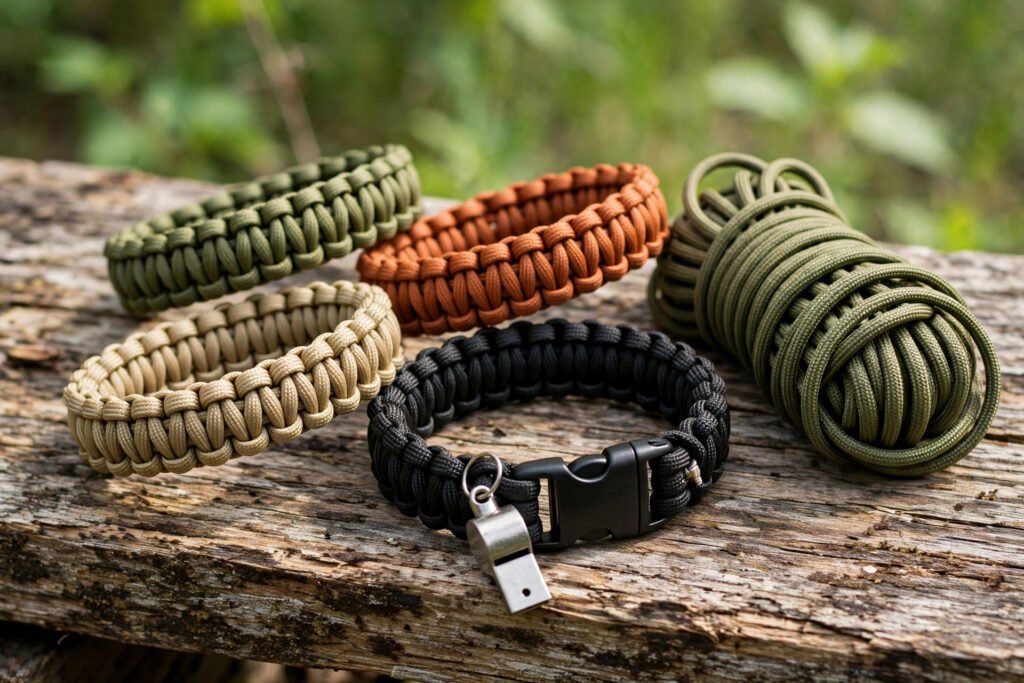
Every survival bracelet promises the same thing: cord on your wrist for the day you need it. The difference between the best survival bracelet for you and a bulky novelty is not the colour or the gadget count. It is four practical things — how much usable cord it actually holds, whether the cord is real 550, how fast you can get it apart, and whether you will still be wearing it after a full day.
This guide breaks down each feature in plain numbers, with honest limits. A bracelet is a backup, not a rescue kit. Chosen well, it is a backup you will actually carry.
If you are comparing finished bracelets side by side, start with our roundup of the best survival bracelets. If you plan to make your own, run your numbers through the Paracord Length Calculator before you cut anything.
How Much Cord Does a Survival Bracelet Actually Hold?
This is the number most listings bury, and it is the one that matters most. A standard cobra weave bracelet for a 7.5-inch wrist typically unravels to about 8 to 10 feet of 550 paracord. A wider king cobra in the same size holds roughly 16 to 20 feet, because it weaves a second layer over the first. A slim fishtail holds less — often 6 to 8 feet.
Those are working estimates, not guarantees. Weave tightness, cord diameter and finished length all shift the total by a foot or more either way. Our paracord length chart shows the same maths across bracelets, belts, leashes and lanyards, and how much paracord do I need explains the roughly 1 foot of cord per 1 inch of finished cobra weave rule behind it.
Is 8 to 10 feet useful? Yes, for the jobs a bracelet is honestly sized for: tying down a load, a short clothesline, lashing a shelter corner, replacing a broken lanyard, or tying gear to a pack. It is not enough to build a full shelter on its own, and no honest seller should claim otherwise.
Do Not Forget the Inner Strands
Real 550 cord contains 7 inner strands. Unpicked, 10 feet of cord becomes about 70 feet of thinner strand — useful for fishing line, sewing repairs, snare wire substitutes where legal, and lashing small items. That strand count is also your authenticity check: if a bracelet unravels to a fluffy filler or fewer strands, it is not 550, whatever the label said.
Weave Matters: Cobra, King Cobra or Fishtail?
Cobra (Solomon bar). The standard. About 1 inch wide, sits flat, unravels relatively quickly by pulling the weave apart knot by knot, and gives you that 8 to 10 feet on an average wrist. For most people, this is the right default.
King cobra. A cobra woven over a cobra. Roughly double the cord, noticeably thicker and stiffer, and slower to take apart because you undo two layers. Worth it if cord quantity is your priority and you do not mind the bulk. Our king cobra paracord bracelet tutorial walks through the weave step by step.
Fishtail. Thinner, neater and more comfortable for small wrists, but it carries the least cord and can be fiddly to unravel with cold hands. Choose it for everyday wear first, emergency cord second.
One honest trade-off applies to all three: the more cord a bracelet holds, the bulkier it is — and a bracelet left in a drawer because it annoys you holds exactly zero feet when you need it.
Buckle Types: The Feature You Will Use Every Day
You will open and close the buckle thousands of times before you ever unravel the bracelet once. Judge it on daily use first.
Plastic side-release buckles (typically 3/8 inch or 5/8 inch) are light, cheap, quiet and easy to work one-handed. A 5/8-inch buckle feels sturdier and is easier with gloves. Their limit is simple: plastic can crack under a hard impact or extreme cold, and it is not a load-bearing connector.
Metal buckles and shackles look and feel tougher and allow small fit adjustments on some designs, but they add weight, can pinch, and may set off metal detectors. An adjustable shackle also changes your finished length, which changes your cord total.
Whistle buckles build a small emergency whistle into the side-release buckle. This is one extra that earns its place: a whistle carries far further than a shout and costs you no extra bulk. Test it once at home — output varies, and a whistle you have never tried is a hope, not a tool.
Fit Is a Safety Feature, Not a Comfort Extra
A bracelet that slides over your hand can slide off in brush or water. One that is too tight gets taken off by lunchtime. Measure properly before you buy or make: our guide on how to measure your wrist for a paracord bracelet gives the exact method and the ease allowance each weave needs. As a rule, a finished cobra should sit snug with roughly one finger of ease — no more.
Fire Starters, Compasses and Other Extras: Worth It?
Ferro rod buckles. A small ferrocerium rod built into a buckle can throw real sparks, but the rod is short, the striker is usually the buckle edge, and it takes practice. Try yours at home first. Treat it as a last-resort backup to a proper fire kit, never a replacement for one.
Button compasses. The tiny compasses set into buckles and straps are the weakest feature on most bracelets. Many are inaccurate near metal and some are off by enough degrees to mislead you. Check one against a known direction before trusting it — and do not navigate by it alone.
Paracord with added cores. Some cord replaces one inner strand with fishing line, fire tinder or wire. It is a legitimate idea for a dedicated kit bracelet, but confirm the cord still has a stated tensile rating and remember that a replaced strand slightly reduces strength. For a first bracelet, plain, verifiable 550 is the safer buy.
The pattern is consistent: extras help only when they work without adding bulk you will not wear. A whistle passes that test. Most other gadgets are a judgement call, not a must-have.
What a Survival Bracelet Cannot Do
Straight talk, because this is where marketing usually leaves the page. A survival bracelet is not climbing gear. Never use paracord — from a bracelet or a spool — for climbing, rappelling or supporting a person’s weight. The 550-pound rating for genuine Type III cord is a static breaking strength for new cord, not a working load, and it drops with knots, abrasion, age and UV exposure.
It is also not a tourniquet, not a tow rope, and not a substitute for carrying proper cord in your pack on a serious trip. Ten feet on your wrist plus a 50 or 100-foot hank in the bag is a sensible system. Ten feet alone is a supplement. That honesty is exactly why the bracelet still earns its place: it is the cord that is with you on the unplanned day, when the pack is at home.
How to Choose: A Simple Checklist
Work through these five checks and you will land on the best survival bracelet for your wrist, not someone else’s:
1. Cord first. Genuine 550 with 7 inner strands and a stated rating. If a listing will not state strand count, skip it.
2. Weave for your priority. Cobra for balance, king cobra for maximum cord, fishtail for slim everyday wear.
3. Count the cord. Expect about 8 to 10 feet from a cobra, 16 to 20 from a king cobra. Making your own? Confirm your cut length in the Paracord Length Calculator before you start.
4. Buckle for daily life. 5/8-inch side-release for gloved hands, whistle buckle if you want one proven extra, metal only if you accept the weight.
5. Fit you measured, not guessed. Use your real wrist measurement plus the weave’s ease allowance — never just small, medium or large.
Buy or make to that list, wear it for a week, and adjust once. A plain bracelet worn daily beats a gadget bracelet abandoned in a drawer every single time.
Frequently Asked Questions
How much paracord is in a survival bracelet?
Typically 8 to 10 feet in a standard cobra weave for a 7.5-inch wrist, 16 to 20 feet in a king cobra, and 6 to 8 feet in a slim fishtail. Exact totals vary with wrist size, weave tightness and cord diameter, which is why makers should check a length chart or calculator rather than guess.
Can you actually use the cord from a survival bracelet?
Yes — once. Unravelling a bracelet is a one-way trip: you get usable cord for lashing, tying and repairs, plus about 7 feet of inner strand per foot of cord, but the bracelet is gone afterwards and must be re-woven or replaced. That is the intended trade in a real emergency.
Is a survival bracelet worth wearing every day?
For people who hike, fish, work outdoors or travel, yes — as a lightweight backup you forget you are wearing. It does not replace cord in your pack, proper tools or a real fire kit. If you would only wear it on trips, a hank of cord in your bag serves you better.
What size survival bracelet should I get?
Measure your wrist snugly with tape or string, then add the ease for the weave — roughly 0.5 to 1 inch for a cobra. Do not rely on small/medium/large labels, which vary by maker. A bracelet that can slip over your hand is too big, and one that leaves deep marks is too small.