
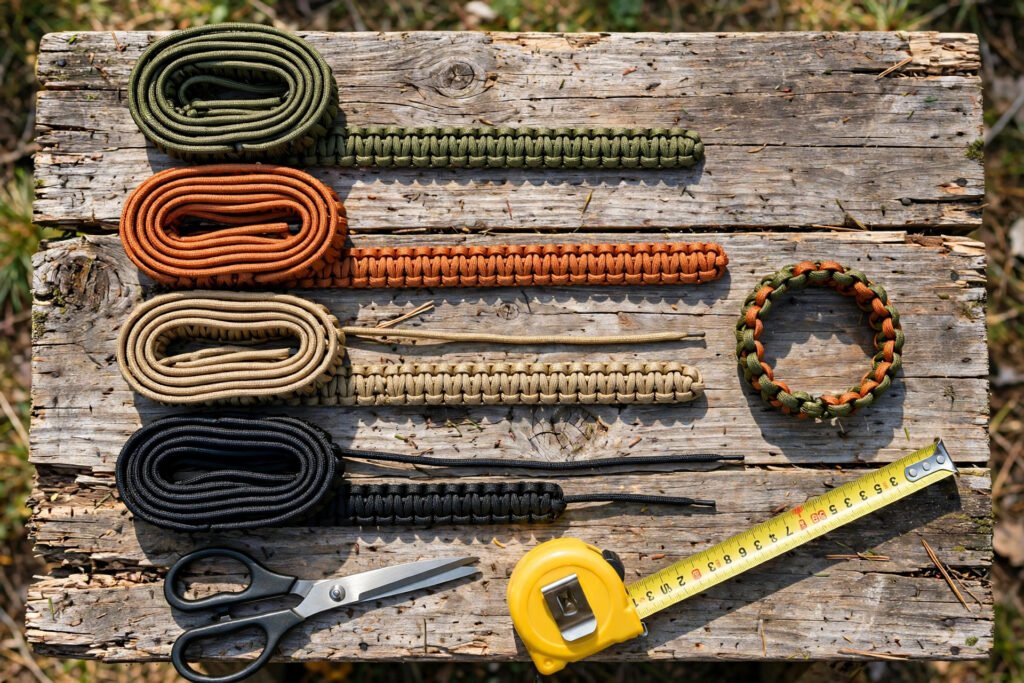
Cut too little paracord and a project dies an inch from the buckle. Cut too much and you waste good cord on every build. A paracord length chart fixes both problems — if the numbers in it are honest about weave rate, wrist size and the extra you need for finishing.
This chart covers the projects people actually make: cobra and king cobra bracelets, lanyards, dog leashes and collars, and a woven belt. Every figure assumes standard 550 cord unless it says otherwise. For an exact number for your wrist and your weave, run the chart figure through the Paracord Length Calculator before you cut — the chart gets you close, the calculator gets you exact.
Paracord length chart at a glance
| Project | Finished size | 550 cord to cut |
|---|---|---|
| Cobra bracelet | 7 inch wrist | 7–8 ft total |
| Cobra bracelet | 8 inch wrist | 8–9 ft total |
| Cobra bracelet | 9 inch wrist | 9–10 ft total |
| King cobra bracelet | 8 inch wrist | 16–19 ft total |
| Fishtail bracelet | 8 inch wrist | 6–7 ft total |
| Trilobite bracelet | 8 inch wrist | 9–11 ft total |
| Neck lanyard | 18 inch loop | 4–5 ft |
| Dog collar, cobra | 16 inch neck | 16–18 ft total |
| Dog leash, cobra | 4 ft finished | 45–55 ft total |
| Woven belt | 36 inch waist | 60–80 ft total |
Read the table the right way: these are starting cuts for average tension. A tight weaver uses a little less, a loose weaver uses a little more, and every project needs finishing room on top. The sections below explain where each number comes from, so you can adjust instead of guessing.
The one rule behind every number: feet per inch
Almost every weave rate is quoted as feet of cord used per inch of finished length. For a standard cobra (Solomon bar) in 550 cord, that rate is about 1 foot of cord per 1 inch of bracelet — split between the two working ends. That is why an 8 inch bracelet needs roughly 8 feet in total, plus finishing extra.
Wider and thicker weaves eat cord faster. A king cobra is a cobra woven over a cobra, so it roughly doubles the rate to about 2 to 2.4 feet per inch. A fishtail sits at the lean end, around 0.75 to 0.85 feet per inch, because it is flatter and uses a single pass. A trilobite lands in between at about 1.2 to 1.4 feet per inch.
Why published charts disagree
Two honest charts can differ by 10–15% and both be right for the hands that made them. Weave tension is the biggest variable: pull every stitch hard and the finished piece stretches less per foot of cord. Cord brand matters too — a true 4 mm 550 cord packs differently from a thin commercial cord sold as 550. Core strands left in or pulled out, and buckle size, also shift the total. Treat any chart, including this one, as a planned starting point, and keep notes on your own builds. After two or three bracelets you will know your personal rate to within a few inches.
Bracelet lengths by wrist size
| Wrist | Cobra total | King cobra total | Fishtail total |
|---|---|---|---|
| 6.5 inch | 6.5–7.5 ft | 13–16 ft | 5–6 ft |
| 7 inch | 7–8 ft | 14–17 ft | 5.5–6.5 ft |
| 7.5 inch | 7.5–8.5 ft | 15–18 ft | 6–6.5 ft |
| 8 inch | 8–9 ft | 16–19 ft | 6–7 ft |
| 8.5 inch | 8.5–9.5 ft | 17–20 ft | 6.5–7.5 ft |
| 9 inch | 9–10 ft | 18–22 ft | 7–8 ft |
Wrist size is not finished bracelet size. A bracelet needs wearing ease on top of a snug wrist measurement — typically about 0.5 inch for a flat weave and up to 1 inch for a thick king cobra, because thickness eats inside circumference. If you have not measured properly yet, start with our guide on how to measure your wrist for a paracord bracelet, then use the finished size, not the raw wrist number, in the chart above.
For two-colour bracelets, split the total roughly in half per colour, then add the finishing extra to both colours — the join and the final melt are where two-colour builds run short. Our king cobra paracord bracelet tutorial walks through the double-layer build step by step once your lengths are cut.
How much extra to add for finishing
The chart totals already assume normal working ends, but add explicit extra in these cases:
- Buckle bracelets: add about 6 inches total for the buckle loops and final tuck and melt.
- Adjustable or knot-and-loop closures: add 8–12 inches — the closure itself is made from working cord.
- First time with a new weave: add 10% across the board. Unpicking and re-tying shortens usable cord, and confidence is cheaper than a restart.
- Two or more colours: add about 4 inches per colour for joins.
Extra cord is not wasted cord. Clean offcuts over about 18 inches coil into a scrap hank for zipper pulls, guy-line repair and practice knots. Offcuts under that go to melting practice — finishing is a skill, and scrap is where you learn it without risking a finished piece. For the finishing technique itself, see our guide on how to finish paracord bracelet ends once your weave is done.
Lanyards, leashes, collars and belts
Lanyards
A simple cobra neck lanyard with an 18 inch finished loop uses about 4–5 feet of 550 cord. A woven wrist lanyard of about 6 inches uses roughly 2–3 feet. Lanyards are the best first project for learning your personal weave rate, because a little too long or short rarely ruins the result.
Dog collars and leashes
A cobra collar scales like a bracelet: about 1 foot per inch of finished collar, so a 16 inch collar needs 16–18 feet including finishing room. A king cobra collar roughly doubles that. A 4 foot cobra leash is a bigger commitment — 45–55 feet in total, usually worked as two long strands — and it is worth laying the full length out before the first stitch so tangles do not stop you mid-weave. Our paracord dog leash guide covers handle and clip construction in detail. Be honest about use: a woven leash is a walking leash, not a tie-out, and no woven collar should be trusted as a dog’s only restraint in traffic.
Belts
A woven belt is where chart ranges get wide, and for good reason: waist size, belt width and weave choice multiply together. A single-cobra belt for a 36 inch waist typically takes 60–80 feet in total, worked in long strands or joined lengths. Plan joins where the buckle and tip finish will hide them, measure the wearer’s actual belt — not their trouser size — and add at least 10% before you start. A belt that comes up 3 inches short cannot be stretched into service.
When the chart is not enough
Use the exact calculator, not a chart range, in three situations. First, expensive or limited cord — a colour you cannot reorder, or the last of a hank. Second, a gift or a paid build, where the finished size has to fit someone else’s wrist, not approximately yours. Third, any new weave you have never made: run the Paracord Length Calculator, cut to its figure plus the first-timer 10%, and write down what you actually used. That note becomes your personal chart entry for next time.
Our broader guide to how much paracord do I need? covers non-woven uses — ridgelines, guy lines, lashing and kit quantities — where length is about the job, not the weave rate. Between that guide, this chart and the calculator, you should never have to guess a cut again.
Quick cutting rules to remember
- Cobra: about 1 ft of cord per inch of finished length.
- King cobra: about double the cobra figure.
- Measure the person or dog, add wearing ease, then look up the chart.
- Add finishing extra separately — 6 inches minimum, 10% for a first attempt.
- Write down what you actually used. Your second build is where the chart becomes exact.
FAQ
How much paracord do I need for an 8 inch cobra bracelet?
Cut 8–9 feet of 550 cord in total. That follows the standard rate of about 1 foot per inch of finished bracelet, plus roughly 6 inches for buckle loops and finishing. Tight weavers land at the low end, loose weavers at the high end.
Why did my bracelet come out short even though I used a chart?
The usual causes are using raw wrist size instead of finished size with wearing ease, weaving looser than the chart assumes, or forgetting that a thick weave eats inside circumference. Add 0.5–1 inch for ease on thick weaves, and add 10% extra cord the first time you make any new pattern.
Does 275 cord use the same lengths as 550?
No. Thinner 275 cord packs tighter and generally uses a little less cord per inch in the same weave, and the finished piece comes out narrower and flatter. Use 550 figures as a safe upper estimate for 275, expect offcuts, and note your actual usage for next time.
What is the best way to get an exact length instead of a range?
Use the Paracord Length Calculator with your finished size and weave, then add the finishing extra for your closure type. Charts give ranges because tension and cord vary; a calculator plus your own build notes is how you narrow a range to a single reliable number.