
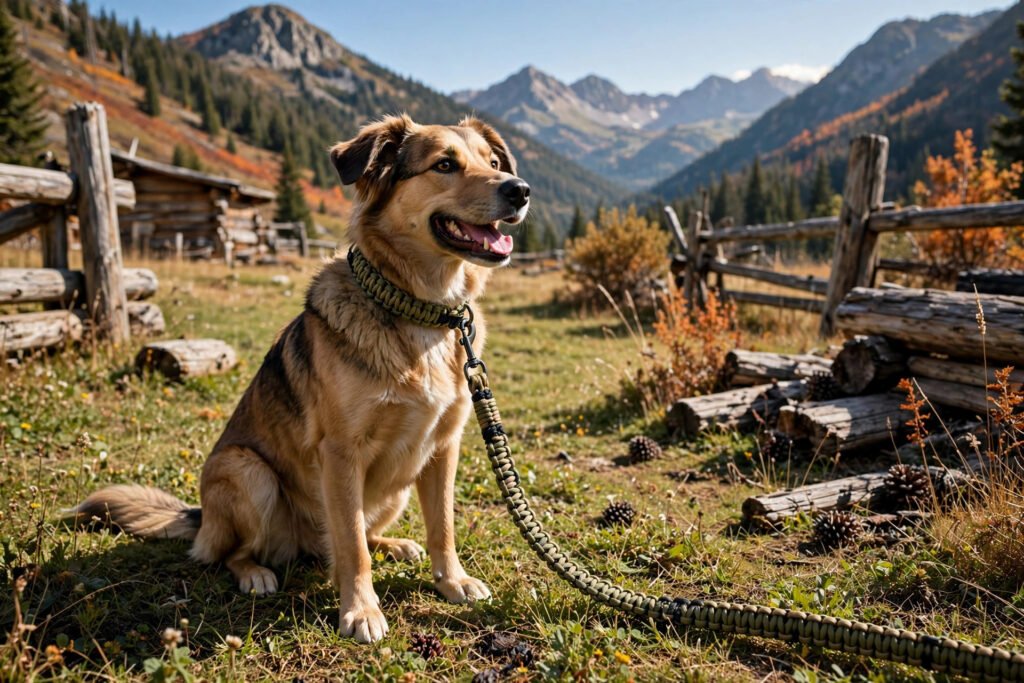
A cobra-weave paracord leash is one of the most useful projects you can make: it is comfortable in the hand, shrugs off water and mud, and can be built to any length with nothing more than cord and a snap hook. It is also a project where guessing the cord amount really hurts — run short at four feet into a six-foot leash and the weave is scrap. So this guide starts with the math, using the same cobra rate as every other project on this site, then gives you the full build.
The leash is built around a two-strand core with the cobra knot woven over it. That structure is strong, keeps the leash flat, and gives the handle loop a clean finish.
What You Need
- 550 paracord, Type III, in one or two colors (see amounts below)
- One metal bolt snap hook — solid brass or stainless steel, sized for your dog (a 3/4-inch or 1-inch snap suits most medium and large dogs); a swivel snap prevents twisting
- Sharp scissors
- Lighter
- Tape measure
- Optional: masking tape to mark your length, and pliers for pulling tight knots
Buy the snap hook like it matters, because it does: on a well-made leash, the hardware is almost always the weakest part, not the cord. Avoid the cheapest zinc die-cast snaps if your dog lunges.
How Much Cord: The Cobra Math
A cobra weave consumes about 12 inches of weaving cord for every finished inch of leash. The two core strands run straight, so each needs the leash length plus about 1.5 ft for the snap hook attachment and the handle loop.
| Leash length | Weaving cord | Core cord (2 strands) | Total to have on hand |
|---|---|---|---|
| 3 ft | 36 ft | 2 × 4.5 ft = 9 ft | ~45 ft |
| 4 ft | 48 ft | 2 × 5.5 ft = 11 ft | ~60 ft |
| 5 ft | 60 ft | 2 × 6.5 ft = 13 ft | ~73 ft |
| 6 ft | 72 ft | 2 × 7.5 ft = 15 ft | ~87 ft |
Worked example, 4 ft leash: cut 48 ft for the weave and two core strands of 5.5 ft each. That is 59 ft total — one 100 ft hank covers it with plenty left over.
Worked example, 6 ft leash: cut 72 ft for the weave and two core strands of 7.5 ft each — 87 ft total. Use a full 100 ft hank and save the remainder for a matching collar or key fob.
Two colors? Do the weave in one color and the core in another, or split the weaving cord in half and join two colors at the middle before you start. Check any other length with the paracord length calculator, and see how much paracord do I need? for the rates behind these numbers. If you have not bought cord yet, our guide to the best paracord explains what separates real 550 cord from the cheap stuff.
The Build
- Cut your cords. One weaving cord and two core strands, per the table above. Melt the cut ends lightly so they do not fray while you work.
- Attach the core to the snap hook. Fold the two core strands together at their midpoint, pass the loop through the eye of the snap hook, and pull the strand ends through the loop (a cow hitch). You now have four strands hanging from the hook; the middle two pairs will act as one combined core — clip or tape two of them together if they separate while you weave.
- Set your working length. Mark the finished leash length on your table with tape, measured from the snap hook. Remember the total includes the handle loop: for a 4 ft leash, plan on roughly 3 ft 3 in of straight weave plus a 9-inch handle loop. Adjust that split to your hand.
- Anchor the weaving cord. Lay its midpoint behind the core strands, just below the snap hook, so equal lengths hang to each side.
- Tie the cobra. Left strand over the core, right strand over the left tail, under the core, and up through the left loop. Next knot from the right side. Alternate every knot — this is the same weave as a cobra bracelet, just longer.
- Keep tension even and the core centered. Every few inches, stop and straighten the core strands and push the knots together. A leash woven with wandering tension will corkscrew when it hangs; fix drift early, because it cannot be pulled out later.
- Stop at the handle point. When your weave reaches the tape mark for the start of the handle, stop tying new knots.
- Form the handle loop. Bend the remaining core back on itself to make a loop big enough for your hand (about 8–9 inches of loop for most adults). Lay the doubled end alongside the finished weave.
- Lock the handle. Weave the remaining working cord over both the core and the returned section for the last 2–3 inches, tying the same cobra knots around the doubled thickness. This binds the loop shut with no sewing.
- Finish the ends. Trim the working ends to 1/4 inch on the underside and melt each into a flat cap pressed against the weave. Trim any core ends flush at the handle binding and melt them the same way.
- Test it before the dog does. Clip it to something solid and pull hard, several times, in short jerks. The knots will settle slightly; nothing should slip or loosen.
Strength and Safety Notes
Read this part before the first walk:
- 550 is a breaking rating, not a working load. Type III cord’s 550 lb figure is minimum breaking strength for the cord alone, under a straight pull. Knots, bends, and abrasion cut real strength substantially — a common rule of thumb treats roughly 110 lb as a safe working load for a single strand. This leash uses a doubled core and many strands in the weave, which helps, but no part of it turns a leash into rated equipment.
- Never use it as a tie-out. A dog left tethered can chew through paracord, and a lunging dog on a fixed line multiplies force far beyond a hand-held walk. This is a walking leash, full stop.
- Not for climbing or towing. Ever, under any circumstances.
- Inspect it monthly. Check the snap hook gate, the handle binding, and any spot your dog’s teeth can reach. Retire the leash if the outer sheath is cut or the white inner strands show.
- Supervise chewers. If your dog mouths the leash, switch to a chain or biothane leash for training and save this one for calm walks.
FAQ
What is the best leash length to build first?
Six feet is the standard walking and training length and gives a dog room to move without excess cord in your hand. Four feet is better for crowded sidewalks and close control. If this is your first weave, the 4 ft version is a more forgiving evening project.
Can I use thinner cord, like 275 or 95 paracord?
Not for the main build. A leash needs the grip thickness and strength of full 550 cord. Thinner cords make a flimsy leash that cuts into your hand under load. Save them for zipper pulls and lanyards.
How do I wash a paracord leash?
Hand-wash in warm water with a drop of dish soap, rinse well, and air-dry out of direct sun. Nylon shrugs off mud and creek water — that washability is half the reason to build one.