
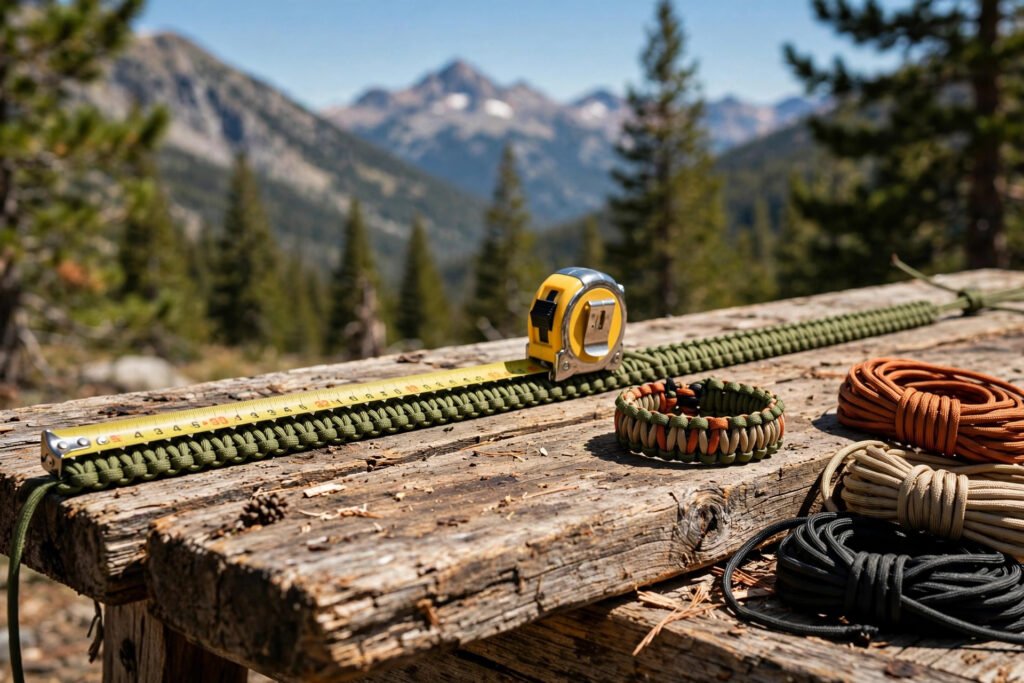
Every paracord project starts with the same moment of doubt: the cord is on the table, the scissors are in your hand, and the pattern just says “cut some paracord.” Cut too short and the project dies two inches from the buckle. Cut wildly long and you waste good cord and fight tangles for an hour.
Skip the guessing. Use the Paracord Length Calculator for an instant answer for your weave and size — and read on if you want to understand the math behind it, because once you know the usage rates, you can size any project on the back of an envelope.
The one rule worth memorizing
A cobra weave uses about 1 foot of cord per finished inch.
That single ratio covers the most common paracord project on earth. A 7.5-inch cobra bracelet needs roughly 7.5 feet of cord. An 8-inch bracelet, 8 feet. It is an approximation — your tension, the cord’s exact diameter, and the core you weave around all nudge it — but it is close enough that generations of makers plan with it. Every other weave is a variation on the same idea: each weave consumes a fixed multiple of the finished length, and your only job is knowing the multiple.
Usage per inch, by weave
These are the working rates we use, the same rates built into the Paracord Length Calculator:
| Weave | Cord used per finished inch | For a 7.5 in piece you cut |
|---|---|---|
| Cobra (Solomon bar) | ~12 in (1 ft) | ~7.5 ft |
| King cobra | ~18–24 in | ~11–15 ft |
| Fishtail | ~7–9 in | ~4.5–5.5 ft |
| Trilobite | ~16 in | ~10 ft |
| Snake knot | ~8–10 in | ~5–6 ft |
| Square knot | ~10–12 in | ~6–7.5 ft |
Why the ranges? Because the multiple is not a law of physics. King cobra is a cobra woven over a cobra, so it roughly doubles — but how proud the first layer sits changes the second layer’s appetite. Tight weavers use less cord on open weaves and sometimes more on dense ones. Treat the table as a planning number, add a margin (below), and you will finish every project with a trimmable tail instead of a shortfall.
Worked example 1: the 7.5-inch bracelet
The classic first project. Finished length 7.5 inches, cobra weave.
- Base math: 7.5 in × 1 ft per inch = 7.5 ft of cord.
- Two colors? Split it: about 3.75 ft of each, joined at the center — call it 4 ft each so the join and the starting tails are covered.
- King cobra instead? Plan on roughly 15 ft and expect to trim.
Measure the wrist, not the bracelet you own: snug wrist measurement plus about half an inch of ease is the finished length to enter. Feed 7.5 and “cobra” into the calculator and it returns the same 7.5 ft — the point of the tool is the projects where the napkin math stops being obvious.
Worked example 2: a dog collar
Collars are where the per-inch rule pays for itself, because the numbers get big enough to embarrass guessers.
Say the dog’s neck measures 16 inches and you want a king cobra collar for the wide, sturdy look.
- Cobra base layer: 16 in × 1 ft = 16 ft.
- King cobra second layer: roughly the same again.
- Total: about 30–32 ft of cord. At 550 cord prices that is a real cut, and guessing “a couple of arm spans” is how collars end up at 14 inches.
A single cobra collar for the same dog is about 16–17 ft. Either way, run your dog’s actual neck size through the Paracord Length Calculator before the scissors come out — collars are the project where one wrong cut wastes the most cord.
Worked example 3: a paracord dog leash
Leashes combine two numbers: the handle weave and the lead itself. A common build is a 4-foot leash with a braided or cobra-wrapped handle section and clips at both ends, which typically lands between 25 and 40 ft of cord depending on how much of the length is woven versus simple braided strands. Because leash designs vary more than bracelets, treat that as a range, then follow the step-by-step in our paracord dog leash tutorial, which sizes its own cuts exactly.
Spool math: how many projects per hank?
Buying cord by the hank or spool, the useful question is projects per package:
- 50 ft hank: about 6 cobra bracelets at 7.5 ft each, or one collar plus a bracelet.
- 100 ft hank: about 13 bracelets, 3 king cobra collars, or a leash and several small projects.
- 1,000 ft spool: kit-stock territory — roughly 130 bracelets, if your hands hold out.
Work it the other way for gifts and batches: projects wanted × feet per project, plus 10 percent for trimming and mistakes, is your order quantity. Cord is cheap; running out mid-batch is not. And if you are restocking, our guide to the best paracord covers which hanks are honest 550 and which are not.
The “cut long” doctrine
Here is the whole philosophy in one line: you can trim excess cord; you cannot add cord mid-weave.
Practical version: take the calculated number and add roughly 10 percent, or a flat extra foot on small projects. Weave with the margin, melt-trim the tails at the end, and keep the offcuts — short lengths become zipper pulls, lanyards, and practice knots. The few cents of cord you “waste” this way are the cheapest insurance in the hobby. The only place to be stingy is when a single cut must come out of an expensive spool for a batch — and even then, the margin shrinks to 5 percent, never zero.
One more variable: two-color projects. Split the total evenly, but give the color that forms the center join an extra few inches, because the join knot eats cord asymmetrically. The calculator’s two-color split already assumes an even split; your extra margin covers the join.
Finally, keep a cutting log. It sounds like homework, but a note on the spool — project, finished size, weave, feet cut, feet trimmed off — turns every build into calibration for the next one. After three or four projects you will know your personal usage rate for your tension and your cord brand, and your estimates will land within inches instead of feet.
FAQ
My bracelet came out shorter than my wrist measurement. Why?
The finished length is measured buckle-tip to buckle-tip, and a snug wrist measurement leaves no wearing ease. Measure your wrist, add about half an inch, and use that as the finished length in the calculator.
Does thicker cord change how much I need?
Yes, somewhat. Type IV (750) is thicker and sits prouder, so dense weaves can consume a little more per inch; thinner 275 cord consumes slightly less in the same weave. The table’s ranges absorb most of this — keep the 10 percent margin and you are covered.
How much cord do I need for a paracord belt?
A cobra belt at a 36-inch waist uses roughly 36–40 ft; king cobra, 65–75 ft. Belts are the strongest argument for the calculator and the cut-long rule combined: nobody wants to discover a shortfall at inch 30.
Can I join two pieces if I run short?
You can melt-join (the “Manny method”) and it holds reasonably, but the join is a weak, stiff spot. On wearables it is a rescue, not a plan. Cut long instead.