
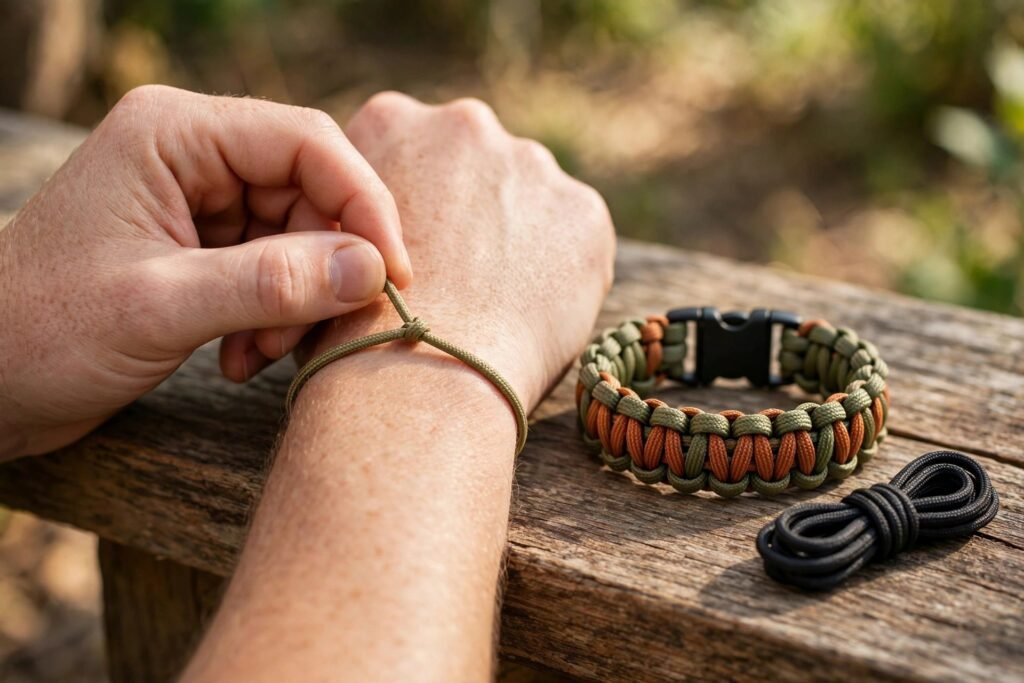
Most paracord bracelets that disappoint do not fail at the weave. They fail at the tape measure, two minutes before the first knot is tied. Set the finished length to your raw wrist measurement and a thick weave will fit like a tourniquet. Guess an extra inch “to be safe” on a thin weave and it will slide over your hand bones and spin all day.
Sizing is not one number. It is two: your snug wrist measurement, and the finished length you actually build to. The gap between them — the allowance — depends on how thick your weave is, what closure you use, and how you like a bracelet to sit. This guide walks through all three steps, with exact numbers for every common weave.
Wrist measurement vs. finished length: the two numbers that matter
Wrist measurement is the circumference of your wrist where the bracelet will sit, taken snug against the skin with nothing added. If your wrist measures 7 inches, that number never changes, no matter what you build.
Finished length is the length of the completed bracelet, measured buckle-tip to buckle-tip with the buckle closed, laid flat. This is the number you set on a bracelet jig, the number you enter into the Paracord Length Calculator, and the number that decides how much cord you cut.
Confusing the two is the single most common sizing mistake. A jig set to 7 inches for a 7-inch wrist produces a bracelet whose inside circumference is shorter than 7 inches once the weave’s thickness is taken into account — because the cord sits on top of itself, the inside of the loop is always smaller than the flat length suggests. The allowance below corrects for that.
How to measure your wrist: 3 methods that work
Method 1: a soft tape measure (most accurate)
Wrap a flexible tailor’s tape around your wrist just behind the wrist bone — the spot where a bracelet naturally rests, on the hand side of the bony bump. Keep the tape flat, snug, and level all the way around. It should touch the skin everywhere without digging in or squeezing. Read the measurement where the zero meets the tape, and write it down to the nearest 1/8 inch. Measure twice; if the readings differ, take the larger one.
Method 2: string or a spare piece of cord (no tape needed)
Wrap a piece of string, a shoelace, or a scrap length of paracord around the same spot, snug in the same way. Pinch or mark the exact point where the end meets the strand, lay it flat, and measure that length against a ruler. It is accurate to about 1/8 inch if you keep the string flat and untwisted. Avoid thick rope — its own thickness adds false length.
Method 3: a paper strip (best for measuring someone else)
Cut a strip of paper about 1/2 inch wide, wrap it around the wrist, and mark where the end overlaps. Measure the strip flat. A narrow strip matters: a wide band bridges over the wrist’s curves and reads long. This is the easiest way to size a child, or someone over the phone with printer paper and a ruler.
Whichever method you use, measure with your hand relaxed. Flexing, or resting the wrist hard on a table edge, can change the reading by 1/4 inch.
The allowance chart: how much to add for each weave
Thickness is what eats fit. A flat fishtail sits close to the skin, so it needs little extra room. A king cobra stands roughly 3/8 inch proud of the core, and that thickness comes straight out of the inside circumference. Use this table as your starting point for a normal, comfortable fit — not tight, not loose:
| Weave | Approx. thickness | Add to wrist measurement |
|---|---|---|
| Fishtail, snake knot, other flat/thin weaves | ~1/4 in | + 1/2 in |
| Cobra (Solomon bar) | ~5/16 in | + 3/4 to 1 in |
| Trilobite and other wide weaves | ~5/16–3/8 in | + 1 in |
| King cobra | ~3/8 in | + 1 to 1 1/2 in |
Worked examples, using those allowances:
| Snug wrist | Cobra finished length | King cobra finished length |
|---|---|---|
| 6.5 in | 7.25–7.5 in | 7.5–8 in |
| 7 in | 7.75–8 in | 8–8.5 in |
| 7.5 in | 8.25–8.5 in | 8.5–9 in |
| 8 in | 8.75–9 in | 9–9.5 in |
Prefer a snug fit that stays put above the wrist bone? Use the low end of the range. Prefer a loose fit that moves a little? Use the high end. If you are between sizes, round up — a bracelet 1/4 inch too large is wearable, while one 1/4 inch too small usually is not.
Once you have the finished length, cord quantity is simple math. A cobra uses about 1 foot of cord per finished inch and a king cobra roughly double that, but run your exact weave and finished length through the Paracord Length Calculator before you cut. For the reasoning behind those rates, see how much paracord do I need?
Closures change the fit, too
Side-release buckles
A buckle adds no length by itself if you measure finished length buckle-tip to buckle-tip with the buckle closed — which is exactly how you should measure. On a jig, set the buckle-to-buckle distance to your finished length. Standard 5/8-inch contoured buckles curve with the wrist and are the most forgiving choice for a first bracelet, as used in our cobra bracelet tutorial with a buckle.
Adjustable knot closures (no buckle)
A loop-and-knot or sliding-knot closure needs the bracelet to open wide enough to pass over the hand. Build the woven section to the same finished length, but check the expanded loop before you finish the ends: if it does not slip over the widest part of the hand, the bracelet is unwearable no matter how perfect the wrist fit is.
Shackles and metal closures
An adjustable shackle gives you roughly 1/4 inch of forgiveness across its pin holes, which makes it a good choice for gifts. Measure the finished length to the middle hole, so the wearer can go one hole tighter or looser.
Sizing a bracelet as a gift (without asking)
If you cannot measure the wrist, work from standard finished lengths and choose a forgiving weave. For a cobra bracelet: about 7.5 inches fits most smaller adult wrists, 8 inches fits most average adult wrists, and 8.5 to 9 inches suits larger wrists. For a king cobra, add roughly 1/2 inch to each of those numbers for the extra thickness — our king cobra paracord bracelet tutorial uses an 8-inch finished length as its middle example for the same reason. When in doubt for a gift, go 1/4 inch larger rather than smaller, and a shackle or adjustable closure buys back the difference.
For children, do not scale by age — wrists vary too much. Use the paper-strip method if you can, and add only 1/2 inch for a cobra: kids outgrow a close fit fast.
5 sizing mistakes that ruin an otherwise good bracelet
1. Measuring over the wrist bone. Measure just behind it, where the bracelet will actually sit. On the bone reads small and the finished bracelet rides tight.
2. Pulling the tape tight. “Snug” means contact, not compression. A squeezed measurement can read 1/4 to 1/2 inch small.
3. Using the same allowance for every weave. The allowance is mostly thickness compensation. A king cobra built with a fishtail allowance will not close comfortably.
4. Measuring a finished bracelet on the outside. Outside circumference overstates fit by the weave’s thickness, twice over. Always judge by buckle-to-buckle flat length against the chart, or by trying it on.
5. Not re-checking before the final melt. Before you trim and melt the ends, close the buckle and try the bracelet on. You should be able to slide one fingertip under the weave, and the bracelet should stay above the wrist bone without being pushed. Too tight at this stage is fixable; after the melt, it is a rebuild.
Quick fit check before you call it done
Put the finished bracelet on. It passes if: the buckle closes without forcing, one fingertip fits under the weave, the bracelet does not slide down over the hand when you shake your arm, and it does not leave a deep cord imprint after five minutes. Pass all four and the sizing is right. Fail the imprint test and rebuild 1/4 to 1/2 inch longer; fail the slide test and rebuild 1/4 inch shorter. Keep a note of the wrist size, weave, and finished length — it turns your next bracelet from a guess into a known number.
FAQ
How do I measure my wrist for a paracord bracelet without a tape measure?
Wrap string, a shoelace, or a scrap piece of paracord snugly around your wrist just behind the wrist bone, mark where it meets, and measure it flat against a ruler. A narrow paper strip works the same way. Both methods are accurate to about 1/8 inch if you keep them flat and untwisted.
How much bigger than my wrist should a paracord bracelet be?
Add about 1/2 inch for thin, flat weaves like fishtail, 3/4 to 1 inch for a standard cobra, and 1 to 1 1/2 inches for a thick king cobra. That total is your finished, buckle-to-buckle length — the number you set on the jig and enter into the calculator.
What is a standard paracord bracelet size?
For a cobra weave, a finished length of about 7.5 inches suits smaller adult wrists, 8 inches suits most average adult wrists, and 8.5 to 9 inches suits larger wrists. Add roughly 1/2 inch to each for a king cobra. These are gift-buying fallbacks — a real wrist measurement is always better.
My finished bracelet is too tight. Can I stretch it?
Not meaningfully. Nylon cord has very little give once woven tight, and forcing it distorts the weave. Wear it for a day — new bracelets settle a small amount — and if it still leaves a deep imprint, rebuild it 1/4 to 1/2 inch longer using the same cord if the weave unpicks cleanly.