
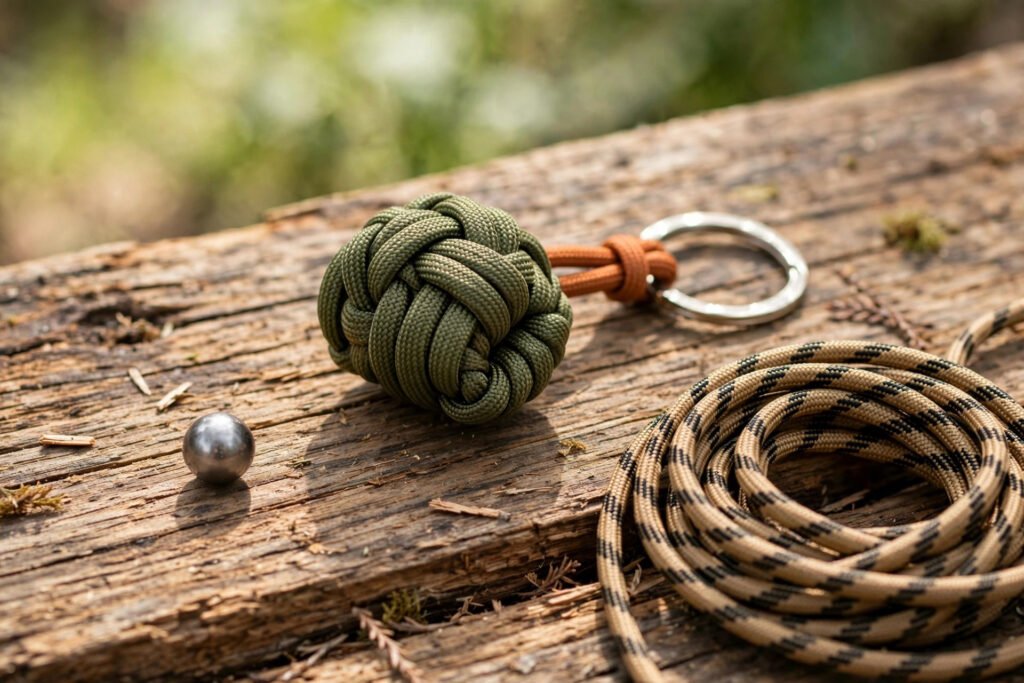
A monkey’s fist keychain looks complicated the first time you see one — a tight, round ball of cord with no obvious start or finish. In reality it is one of the best beginner projects you can make. It uses one piece of cord, three sets of wraps, and patience when you tighten it. No buckle, no jig, and no special tools.
It is also practical. A keychain-size fist carries 5 to 10 feet of usable 550 paracord in your palm — cord for a zipper repair, a shoelace, or a quick lashing when unraveled. Made smaller, it becomes a zipper pull. Keep it as a keychain and cord carrier, especially with a heavy steel core, because laws on weighted fists vary by place.
This guide gives you exact cord lengths for each core size, the wrap sequence in plain language, and the tightening method that separates a tight, round fist from a loose, lopsided one.
What You Need
You need four things, and you probably own three of them already:
- 550 paracord: one continuous piece. See the length table below — 5 to 10 feet covers most keychain sizes. Olive, burnt orange, tan, and black all hide dirt well.
- A round core: a glass marble, a wooden bead, or a steel ball bearing. The core sets the finished size. A 5/8-inch (16 mm) marble is the easiest starting point.
- A key ring: a standard 1-inch split ring, or a small carabiner if you prefer to clip it to a bag.
- Scissors and a lighter: for the final trim and melt. Our guide to how to finish paracord bracelet ends covers the clean melt-and-tuck method, and it works exactly the same here.
Optional: needle-nose pliers help with the last tightens.
How Much Cord Do You Need?
This is where most first attempts fail — not on the wraps, but on cutting the cord too short. A monkey’s fist uses far more cord than it looks like it should, because three wraps in three directions stack up fast, and you still need a working tail for the loop.
| Core size | Finished fist (approx.) | Wraps per direction | 550 cord to cut |
|---|---|---|---|
| 5/8 in (16 mm) marble | ~1 in | 3 | 5 feet |
| 3/4 in (19 mm) marble or wood bead | ~1 1/4 in | 3 | 6 to 7 feet |
| 7/8 in (22 mm) core | ~1 1/2 in | 3 to 4 | 8 to 9 feet |
| 1 in (25 mm) steel ball | ~1 5/8 in | 4 | 10 feet |
Those figures include about 12 inches extra for the loop and tightening slack. For a two-tone fist, join two half-length pieces with a clean melt joint first.
Not sure how your size scales to other projects? Run your numbers through our Paracord Length Calculator before you cut, and compare your result with the full paracord length chart for bracelets, belts, leashes, and lanyards. If you are still learning how cord estimates work in general, how much paracord do I need explains the method behind every number in the table.
Step-by-Step: Tying the Monkey’s Fist
Work loose. The single most important rule in this whole guide is to keep every wrap loose until all three directions are in place. Tightening comes last, in its own stage.
Step 1: The vertical wraps
Leave a 12-inch tail hanging — this becomes half of your loop. Hold the core between your index and middle finger, or rest it in the palm of one hand. Wrap the long end of the cord vertically around the core and around two fingers of your other hand, keeping the wraps side by side, not stacked. Make 3 full wraps for a marble-size core, 4 for a 1-inch core. The wraps should look like neat parallel bands.
Step 2: The horizontal wraps
Without letting the first wraps spring open, turn your hand 90 degrees and wrap horizontally around the middle of the vertical wraps. These second wraps go around the outside of the first set and squeeze them together at the centre. Make the same number of wraps — 3 for a small fist, 4 for a large one. Keep them parallel and loose.
Step 3: Insert the core if you have not already
If you wrapped around your fingers instead of directly around the core, this is the moment to slip the marble or ball into the centre pocket formed by the first two sets of wraps. Seat it dead centre. If it sits off to one side, the finished fist will bulge, and no amount of tightening will fully fix it.
Step 4: The final vertical wraps — through the middle
Now wrap vertically again, but this time the cord passes inside the horizontal wraps and outside the first vertical wraps. In plain terms: each new wrap threads through the gap left by the horizontal band, locking all three directions together. Make the same count again — 3 or 4 wraps. When you finish, the ball should be caged on all sides, still loose, with two cord ends emerging near each other at the top.
Step 5: Tighten slowly, one wrap at a time
Do not pull one end hard and hope for the best. That is how you get a fist that is tight on one side and baggy on the other. Instead, work around the ball following a single wrap from start to finish, pulling a small amount of slack through each section, then move to the next wrap. Go around the whole fist two or three times. Each pass should take out less slack than the one before. The fist is done tightening when it feels solid, the wraps sit in even parallel lines, and the core does not rattle or shift when you squeeze it.
Expect 5 to 10 minutes here on your first attempt. That is normal — rushed tightening ruins more fists than any other mistake.
Adding the Loop and Key Ring
With the fist tight, you should have two ends at the top: the 12-inch tail you left at the start and the working end. Thread the key ring onto one end. Then tie the two ends together so they form a loop of about 2 to 3 inches — a simple, secure way is a double fisherman’s-style join or a neat figure-eight on a bight, pulled snug against the top of the fist so the knot hides in the wraps.
Trim any excess to about 1/4 inch, melt the cut ends with a lighter until they just gloss over, and press them flat against the knot while they are still warm. Do not hold the flame on the cord — two to three seconds is enough for 550 cord, and a scorched, blackened end is a sign the flame stayed too long.
Common Beginner Mistakes
Cutting the cord too short
The table above already includes your tightening slack. If you cut to the exact wrap length with nothing spare, you will run out of cord on the final pass. When in doubt, cut 12 inches long and trim the excess at the end. Cord is cheap; restarting is annoying.
Tightening too early
If the first wraps are tight, the later wraps will not thread through cleanly and the core will not seat in the centre. Loose first, tight last — in that order, every time.
Skipping the core
You can tie a monkey’s fist with no core, but a coreless fist in 550 cord collapses and loses its round shape within days of pocket carry. A marble costs almost nothing and makes the knot hold its form. For a smaller, lighter version — a zipper pull, for example — use 275 cord around a 3/8-inch bead and cut about 3 feet.
Uneven wrap counts
Every direction needs the same number of wraps. Three vertical, three horizontal, and two in the final direction leaves a visible gap that tightening cannot close. Count out loud if you have to.
Variations Worth Trying Next
Once your first fist is tight, the same knot scales easily. A two-colour fist — olive with a burnt-orange final wrap set — is the easiest upgrade and needs no new skill. A pair of small fists on a short loop makes a strong bag pull.
If this is your first finished project, it pairs well with the other builds in our paracord crafts for beginners guide and the wider list of easy paracord projects for beginners — each one teaches a different core skill, and the fist teaches the most transferable one of all: managing slack.
Before you start your second fist, run the size you want through the Paracord Length Calculator one more time. Getting the length right before you cut is the habit that makes every project after this one faster.
Frequently Asked Questions
How much paracord do I need for a monkey’s fist keychain?
For a standard keychain made with 550 cord around a 5/8-inch marble, cut 5 feet. A 3/4-inch core needs 6 to 7 feet, and a 1-inch core with 4 wraps per direction needs about 10 feet. Those amounts include roughly 12 inches for the hanging loop and tightening slack.
Can I make a monkey’s fist without a core?
Yes, but it will not stay round. Without a marble, bead, or ball inside, a 550-cord fist flattens with normal pocket carry. A cheap glass marble fixes the problem and makes the knot much easier to tighten evenly, especially for beginners.
Is a monkey’s fist keychain legal to carry?
A plain cord keychain is fine in most places, but a fist built around a heavy steel ball can be treated as a weighted weapon in some jurisdictions. Laws vary. If you want zero ambiguity, use a marble or wooden bead core and carry it as what it is — a keychain and a compact way to carry spare cord.
Why does my monkey’s fist look lopsided?
Almost always one of two causes: the core was not centred before the final wraps, or the tightening was done by pulling one end instead of working the slack around wrap by wrap. Loosen it, re-centre the core, and tighten in two or three slow passes around the whole ball.