
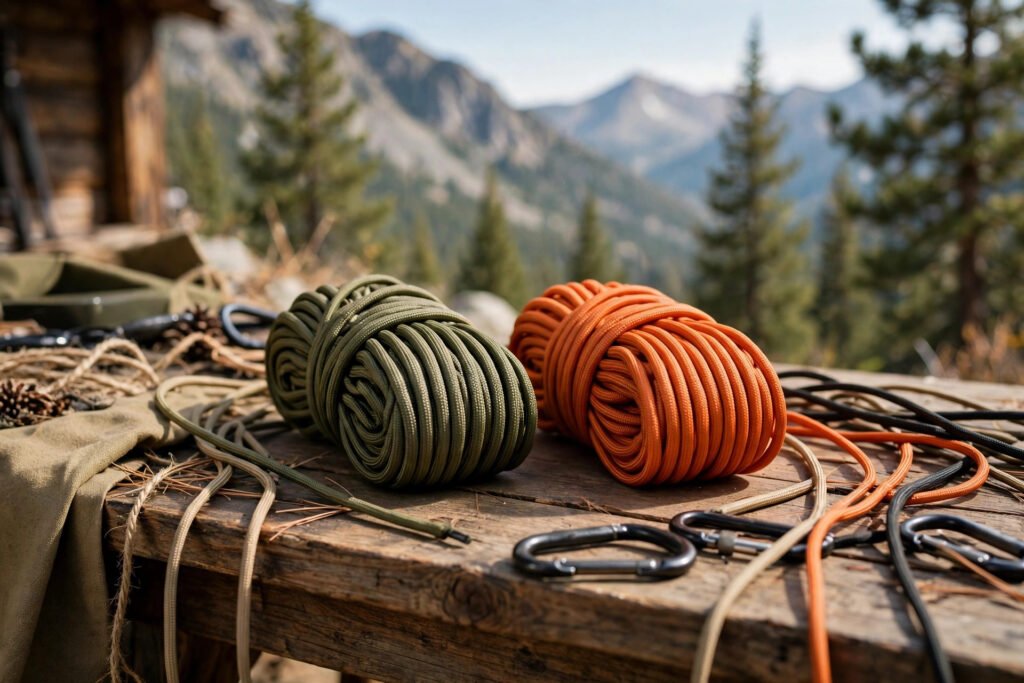
The Label Is Not the Spec
Walk into any surplus store or scroll any marketplace and you will drown in “mil-spec” paracord. Almost none of it is. “Military style,” “mil-spec grade,” “made to military specifications” — these phrases are marketing, and they are legal precisely because they promise nothing specific. Actual mil-spec cord is a defined product made under a defined standard by a short list of certified US manufacturers, and it costs more than the imitation for boring, verifiable reasons.
This does not mean commercial paracord is junk. Good commercial Type III is honestly made, honestly rated and right for most jobs. The problem is only the lying — cord dressed in military language it has not earned, and no-name cord that borrows the 550 number without the construction behind it. Here is how to tell the three apart.
What MIL-C-5040H Actually Requires
MIL-C-5040H is the US military specification for fibrous nylon cord — the parachute cord standard. For Type III cord, the cord most people call 550, it requires in substance:
- Construction: a braided nylon sheath over a core of 7 inner strands, each strand made of twisted nylon yarns (each yarn itself 3 plies).
- Minimum break strength: 550 lb for Type III, tested to the standard’s method.
- A colored identification yarn running inside the core, identifying the manufacturer — this is how inspectors trace a spool back to its maker.
- Tested properties beyond strength: the spec also covers things like elongation, sheath slippage, abrasion behavior and colorfastness, verified through lot testing.
- Certified production: genuine mil-spec cord is bought under government contract from approved manufacturers, and civilian sellers of the real article can name their source in that chain.
That combination — certified maker, traceable lot, tested properties — is what “mil-spec” means. A cord can match the Type III dimensions and strength and still not be mil-spec, because nobody certified or tested it to the document. And a cord can carry “mil-spec” on a printed card while matching nothing at all.
The Certified-Supplier Reality
Only a handful of US companies manufacture cord under the mil-spec program, and genuine mil-spec 550 reaches the civilian market through a small number of sellers who buy from them or from government surplus channels. Two consequences follow.
First, real mil-spec cord has a price floor. Certified production, US labor and lot testing cost what they cost. Cord advertised as mil-spec at a fraction of the price of every known genuine seller is not a bargain; it is a story.
Second, honest sellers of the real thing can tell you where it came from. TITAN Survival, the best-known civilian mil-spec brand, states plainly that its cord is made in the USA by certified US government contractors to the MIL-C-5040H standard. That is the shape of a credible claim: a named standard, a named origin, a checkable story. Our best paracord guide lists what to verify on any cord, mil-spec or not.
Commercial Cord: The Honest Middle
Between certified mil-spec and outright fakes sits the largest and most useful category: commercial Type III cord from reputable makers. Atwood Rope, Paracord Planet and Bored Paracord sell 550 cord built to the same basic design — 7-strand nylon core, braided nylon sheath, 550 lb class break strength — without claiming government certification.
For bracelets, crafts, camping and most utility work, that cord is not a compromise. It is the right tool at the right price, and the colors and patterns available exist because of the commercial market. The distinction that matters is not commercial versus mil-spec. It is honest versus dishonest labeling. A maker who publishes strand count, material and diameter is selling you a product; a maker who publishes adjectives is selling you a feeling.
Our explainer on what 550 paracord is covers the type system itself if you want the background before judging any label.
Label Red Flags: The Fake-Spotting Checklist
Run any suspect listing or package against these:
- “Mil-spec” with no standard named. The real standard is MIL-C-5040H. If the seller cannot or will not name it, the claim is decoration.
- “Military grade,” “army style,” “tactical 550.” None of these phrases refer to any specification that exists.
- Strength claims above the type. “1000 lb paracord” that is also somehow standard 4 mm, 7-strand 550 is inventing physics. Types cap out at known values for a given construction.
- No strand count or material listed. Or worse, a strand count that contradicts the type — “750 paracord, 7 strands” is mislabeled by definition, since Type IV has 11.
- Too-cheap pricing. Sustained prices far below every established maker mean the construction has been cut somewhere: polyester instead of nylon, filler instead of strands, thinner diameter.
- Weight that is too light. A 100 ft hank of real 550 weighs roughly 7–8 oz. A noticeably lighter hank is missing material — usually core.
- Seller with no traceable identity. Genuine sellers have names, histories and spec sheets. Fakes hide behind rotating storefronts.
Hands-On Tests That Settle It
Labels argue; cord confesses. Three checks you can do on any hank:
Strip and count. Cut a short piece, slide the sheath back and count the inner strands: 7 for Type III, and each strand should be twisted yarns, not loose fluff. If you find a single wadded filler, you have decoration cord.
Find the marker yarn. Genuine mil-spec cord carries a colored identification yarn among the core strands — its presence is a strong (though not absolute) sign of true-spec production, and fakes rarely bother to include one.
Measure and weigh. Around 4 mm diameter and around 7–8 oz per 100 ft for 550. Undersized on either measure means undersized strength, whatever the card says.
The Break-Strength Truth Nobody Prints
Even genuine 550 cord deserves honest handling of its number. The 550 lb figure is a minimum breaking strength for new cord, straight pull, tested under the standard’s conditions. In the field:
- Knots reduce a rope’s strength substantially — figures of 30–50% loss depending on the knot are commonly cited.
- Abrasion, UV exposure, age and repeated loading all reduce strength further.
- Shock loads multiply forces far beyond the static weight.
Which is why paracord — mil-spec included — is never life-safety equipment. It is not for climbing, fall protection, towing or overhead loads. Mil-spec certification means the cord honestly meets its published minimums. It does not raise those minimums into a different class of gear. Anyone selling it as if it does is the biggest red flag of all.
So Which Should You Buy?
Buy mil-spec when the cord is insurance: survival kits, emergency vehicle kits, and any job where “probably fine” is not the standard you want, and where you are paying for verified, traceable construction from sellers like TITAN Survival who name their standard and source.
Buy quality commercial cord for everything else — weaving, camp chores, repairs, practice — from makers who publish real specs. Spend the savings on more cord and better hardware.
Skip anything that trips the red-flag list. There is enough honestly labeled cord in the world that nobody needs to fund the fakes.
If you are ready to compare specific cords by job, the best paracord guide applies these same checks to the main use cases.
FAQ
Is all mil-spec paracord made in the USA?
Genuine MIL-C-5040H cord comes from certified US manufacturers producing under the specification, and credible sellers state the origin plainly. A “mil-spec” claim with no country of origin and no named standard should be treated as unproven.
Is commercial 550 cord weaker than mil-spec 550?
Both are Type III with a 550 lb minimum break strength by design. The difference is assurance: mil-spec cord is produced and lot-tested under the standard by a certified maker, while commercial cord’s rating rests on the maker’s own claims and reputation. With a reputable commercial maker, real-world strength is comparable; with an anonymous one, nothing is guaranteed.
What does the colored thread inside paracord mean?
It is the manufacturer’s identification yarn required by the military specification — a traceability marker that identifies which certified maker produced the cord. Finding one inside a cord is a good sign; its absence does not automatically condemn commercial cord, which is not required to include one.
Can mil-spec paracord be used for climbing?
No. No paracord of any type or certification is rated for climbing or life safety. The minimum break strength, before knots and wear, is far below what those activities require, and the cord is not tested or certified for dynamic falls. Use certified climbing equipment.