
A bend knot joins two cords, lines or ropes together, end to end. If you only learn one bend, learn the sheet bend: it is simple, it holds, and it is considered so essential that it is knot No. 1 in The Ashley Book of Knots.
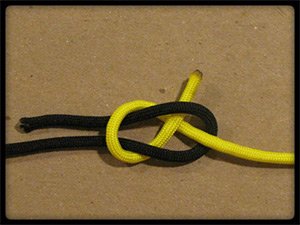
The sheet bend is the knot to reach for when you need one longer line made from two shorter ones — joining the inner strands of gutted paracord into fishing line, extending a guy line, or tying two ropes together at camp. It works best on ropes of similar diameter; for ropes of very different sizes, tie a doubled sheet bend instead (a single sheet bend on unequal diameters is insecure and will most likely not hold).
When to use a sheet bend
- Joining two ropes of similar size. This is the sheet bend’s home ground.
- Extending a line. Two short cords become one long one — the same job it does when you tie gutted paracord strands together for fishing line.
- Ropes of unequal diameter. Double the knot (wrap the working end around a second time) before tightening.
Do not use a bend knot for climbing, fall protection, or any life-safety load — paracord and knots are not rated for that. And if you are tying the two ends of the same rope together, you want a reef knot instead: bends join two ropes, binding knots tie the ends of one.
What you need
- Two cords or ropes to join (this tutorial uses a yellow cord and a black cord, so you can follow which end goes where)
- A flat surface to work on
How to tie a sheet bend
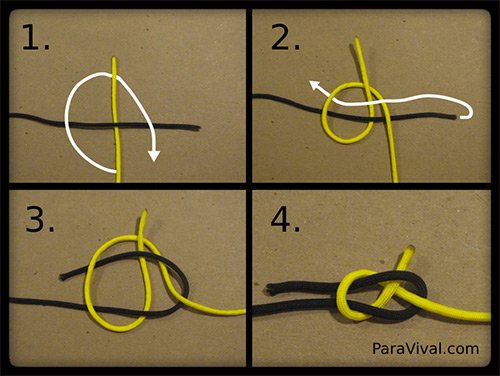
- Cross the two loose ends of cord over one another. Take the longer end of the yellow cord and bring it up and behind the loose end and back down over the black loose end.
- Take your black loose end and bring it through the loop formed with the yellow cord.
- Check the shape: it should look like the diagram — the black end coming up through the yellow loop, ready to be tucked.
- After tightening slightly, it should look like the finished diagram. Make sure both loose ends end up on the same side as each other — notice both loose ends are on the top in part 4 of the diagram.
Tips
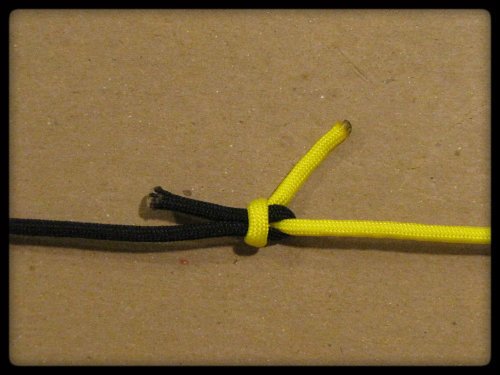
- Same side, every time. The safety of the sheet bend comes from both loose ends finishing on the same side. If one ends up on the opposite side, untie and retie — it is a different, weaker knot.
- Dress it before you load it. Pull both standing ends to snug the knot down evenly, then pull each loose end to take out slack. A dressed sheet bend holds; a sloppy one slips.
- Double it for mismatched rope. When the two ropes are very different diameters, wrap the working end around the loop a second time before tucking it through — that is the double sheet bend, and it is the secure version for the job.
The Finished Sheet Bend Knot
Where to use it
The sheet bend earns its place in a kit because it turns short lengths into long ones. Gutted paracord strands tied together with sheet bends become a fishing line (see paracord fishing for the full method), and the same knot extends guy lines and lashings without a trip back to the spool. When you are sizing cord for a project that will use joins like this, run the numbers through the Paracord Length Calculator first — a joined line is only as good as the cord you cut for it.
FAQ
Can a sheet bend join ropes of different sizes?
Yes — but double it. A single sheet bend on ropes of unequal diameter is insecure and will most likely not hold. Wrap the working end around a second time before tucking it through, and the knot becomes the double sheet bend, which handles the mismatch safely.
What is the difference between a sheet bend and a reef knot?
A sheet bend joins two separate ropes together. A reef knot ties two ends of the same rope together around something — it is a binding knot, not a bend, and it slips badly if you try to use it to join two ropes. Use the right knot for the job: sheet bend for joining, reef knot for binding.